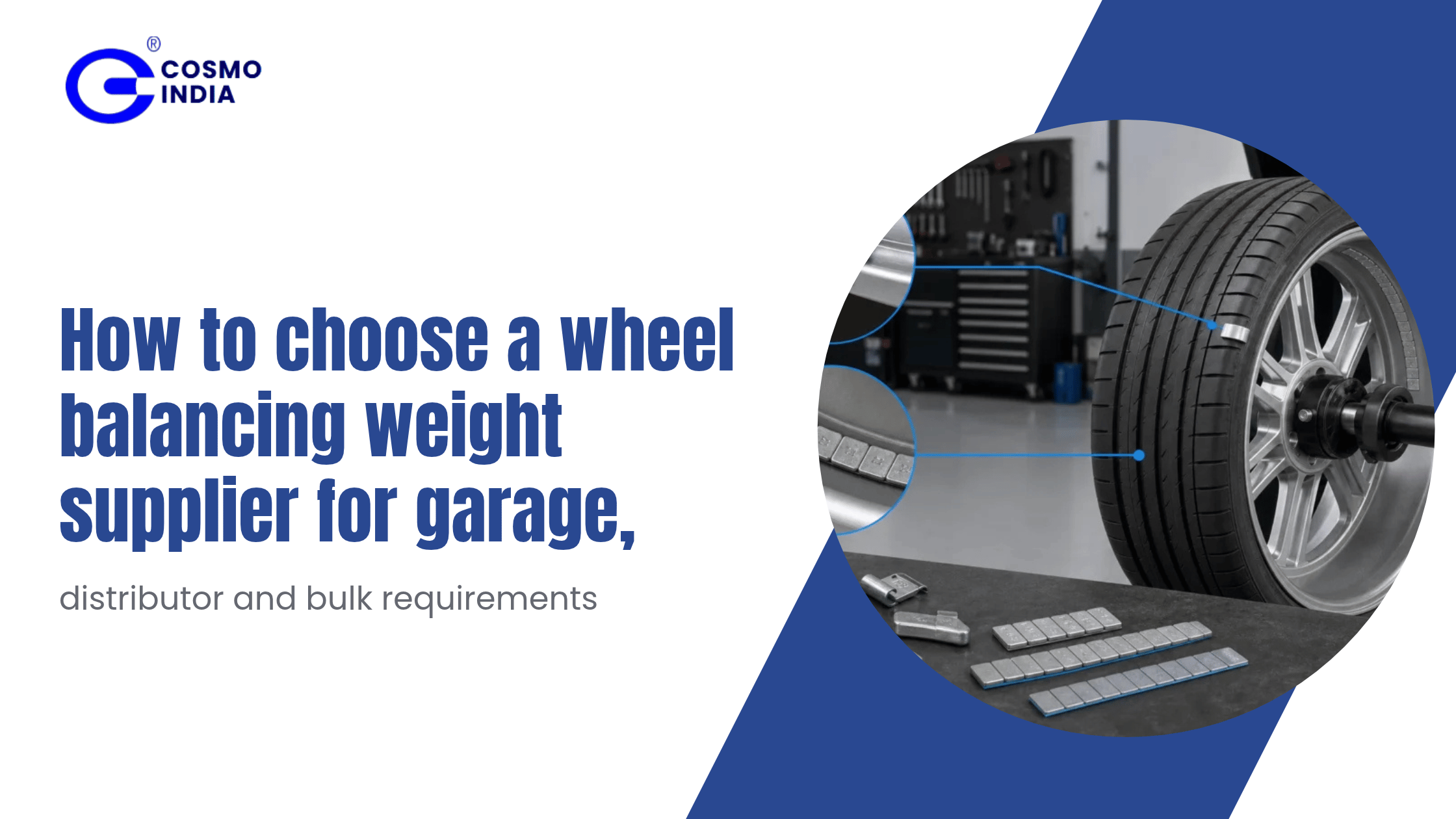
Choose a wheel balancing weight supplier by checking the things that show up later in your workshop: whether the range covers the wheels you actually service, whether the grams stamped on the weights are the grams you get, whether clips hold and tape sticks, and whether the next box matches the last one. Price matters, but it sits after those checks, because a cheap weight that falls off costs a repeat job. The framework below runs by buyer type first, then by the checks every buyer should make.
Start with your buyer type
A single garage, a distributor and an OEM buyer are not buying the same thing, even when the product in the box looks identical.
| Buyer type | What matters most | What to check first |
|---|---|---|
| Single garage or tyre shop | Coverage of daily work, weights that fit first time | Range of profiles and grams, strip quality, sensible pack sizes |
| Distributor or wholesaler | Consistency across volume, packaging that resells well | Box-to-box consistency, branding and labelling, supply continuity |
| Fleet workshop | Repeatability across many similar vehicles | Gram accuracy, coating durability, dependable reordering |
| OEM or bulk buyer | Documented quality, traceability, capacity | Certifications, quality systems, production capacity, samples and testing |
A supplier strong for one type is not automatically right for another: OEM volumes can mean minimum quantities a garage cannot use, while a good local stockist may hold no documentation an OEM audit requires.
Check the range: types, grams and profiles
Ask what the supplier actually stocks or makes, in detail. You need both fixing methods — clip-on weights for flange rims and adhesive weights for alloy rims — because your customers’ wheels decide which one a job takes. Within clip-on, the profile has to match the flange, so a range of profiles matters more than a long gram list in one profile. Within adhesive, check the forms on offer: pieces, strips and rolls serve different work, with rolls suiting in-plant and high-volume use.
Gram coverage should run in small steps across the sizes you use most. A range that starts too high or jumps in large steps forces technicians to stack weights or accept a near-enough balance. The types of wheel balancing weights guide shows the full spread a working range has to cover.
Materials on offer, and why the choice matters
A supplier should be able to offer, and explain, more than one material. Steel is the common lead-free option, zinc is the other main lead-free material, and lead remains in use where regulations and customers allow it. Which you stock depends on your market: export and OEM work increasingly specifies lead-free, while some domestic segments still buy lead.
Treat a vague answer here as a warning. A supplier who cannot say what a weight is made of, or who labels everything with one word regardless of the box, is telling you how the rest of the relationship will go. The differences between the materials are set out in the guide to what wheel balancing weights are made of.
Accuracy and consistency from box to box
A weight’s whole job is to be exactly the mass stamped on it. Weigh samples on a scale. A 25-gram weight that carries 23 grams makes every balance it touches wrong by that amount, and the driver may still feel the poorer result.
Consistency is the larger half of this check. One good sample proves little. Ask how tolerance is controlled in production, and compare weights from different boxes in the same order. Imperial Supplies’ discussion of wheel weights as an investment makes the commercial version of the point: the saving from poor weights is small next to the cost of comebacks.
Coating, clip and tape quality
Three physical details decide whether a fitted weight stays fitted. On clip-on weights, the clip should be springy, correctly shaped for its profile and resistant to rust; a clip that has lost its tension is a weight waiting to leave the flange. The coating protects the body against corrosion from monsoon water and road treatment.
On adhesive weights, the tape is the product. It should bond firmly to a cleaned rim, hold across the temperature range the wheel sees, and peel from its liner without tearing. Ask what temperature range the adhesive is rated for, and test strips on a real rim before ordering in volume.
Packaging and supply continuity
Packaging is a workshop issue, not a cosmetic one. Weights should arrive sorted by type and gram value, protected from moisture, in pack sizes a technician can keep at the machine. Mixed, unlabelled bulk packing slows every job and invites wrong-weight errors.
Continuity matters just as much. Ask about lead times, minimum quantities and mid-season reordering. A supplier who disappears for a month in your busiest period costs more than a slightly higher unit price, and distributors should confirm that profiles and gram markings stay unchanged across orders.
Certifications and quality systems
For OEM, export and fleet work, ask what quality system the manufacturing runs under and expect documents, not adjectives. IATF 16949 is the automotive quality certification relevant to component supply; ISO 14001 and ISO 45001 cover environmental and workplace-safety management. A supplier holding these can show certificates with validity dates and an issuing body.
A garage does not need the same paperwork, but the answer is still evidence: a factory running an audited quality system usually holds tolerances and materials control more consistently. How to assess the manufacturer behind the supplier is covered in the guide to choosing a wheel balancing weights manufacturer in India.
Samples before you commit to bulk
Never let the first full order be the test. Request samples of the exact profiles, grams and materials you plan to stock, then run your own checks: weigh them, fit them to the rims you service most, work adhesive strips for a week, and check clips after removal. Compare the delivered bulk order against the samples you approved.
Honest suppliers separate themselves here. A supplier confident in the product sends samples readily and expects the comparison; reluctance, or samples that differ from production stock, tells you to keep looking.
“Near me”, regional searches and buying direct
Many buyers search for wheel balancing weights near me, or name a city — wheel balancing weights manufacturers in Coimbatore, for example, which is a natural search in a region with a large vehicle and engineering base. The honest answer to every such search is the same: a local stockist and a distant manufacturer are different offers, and neither is automatically better.
A local stockist gives you stock today, in small quantities. A manufacturer shipping to you gives you the full range and direct accountability for quality, at the cost of lead time. Many garages use both: the stockist for urgent top-ups, the manufacturer for planned stock. Judge any regional supplier by the checks in this article — range, accuracy, clip and tape quality, continuity — not by distance alone. What goes into the price you are quoted is broken down in the wheel balancing weights price guide, and the retail and marketplace routes in the guide to where to buy wheel balancing weights.
Mistakes when choosing a supplier
Choosing on unit price alone. The weight is a small part of a balancing job’s cost; a comeback is a large one.
Skipping the scale test. Stamped grams that are not real grams make every balance wrong by a built-in error.
Ordering bulk before samples. The first order should confirm the samples, never replace testing them.
Ignoring the adhesive rating. Tape that fails in heat or cold turns a good price into a box of returns.
Buying a range shaped by the seller’s stock, not your work. Profiles you do not need do not compensate for missing grams you use daily.
Never re-checking. Suppliers change materials and sources; a quick sample check on each consignment keeps the standard where you set it.
Frequently asked questions
Where can I buy wheel balancing weights?
From a local stockist or tyre-equipment dealer for small, urgent quantities, from a distributor for regular trade volumes, or directly from a manufacturer for the full range and bulk requirements. The right route depends on quantity, urgency and how much documentation you need.
What should I check before buying wheel balancing weights in bulk?
Range and gram coverage for the wheels you service, the materials on offer, stamped-weight accuracy checked on a scale, clip tension and coating on clip-on weights, tape quality and temperature rating on adhesive weights, packaging, lead times, and the supplier’s certifications. Test samples in your own workshop before the bulk order.
Is it better to buy from a manufacturer or a local supplier?
Each solves a different problem. A manufacturer offers range, consistency and direct accountability, with lead times and usually minimum quantities. A local supplier offers immediacy and small quantities. Many workshops buy planned stock from a manufacturer and top up locally.
Which certifications should a wheel balancing weight supplier have?
For OEM and export supply, look for IATF 16949 as the core automotive quality certification, with ISO 14001 and ISO 45001 as supporting management certifications. Ask to see current certificates rather than accepting a claim, whatever size of buyer you are.
Why do prices differ so much between suppliers?
Material, accuracy, coating and tape quality, packaging and order quantity all move the price, and the lowest quote usually saves on one of the invisible items — tolerance, clip steel or adhesive. The price guide linked in this article breaks down each factor.
Does Cosmo India supply garages and distributors as well as OEMs?
Cosmo India is a manufacturer and OEM supplier of wheel balancing weights, producing clip-on weights from 5 to 100 grams and adhesive weights as pieces, strips and rolls, in steel, lead and zinc. Garages and distributors can enquire about supply for their requirements at info@cosmo.co.in; the range is shown on the products page.
Sourcing from Cosmo India
Cosmo India has manufactured wheel balancing weights in Gurugram for over 25 years, with a plant capacity of 50 million parts per annum. The company supplies OEM customers — its named clients include Maruti Suzuki, Mahindra & Mahindra, Tata Motors, Fiat and Wheels India — and holds IATF 16949, ISO 14001, ISO 45001 and ZED Gold certifications. If you are evaluating suppliers against the checks in this article, start with the products page and send your requirement to info@cosmo.co.in.