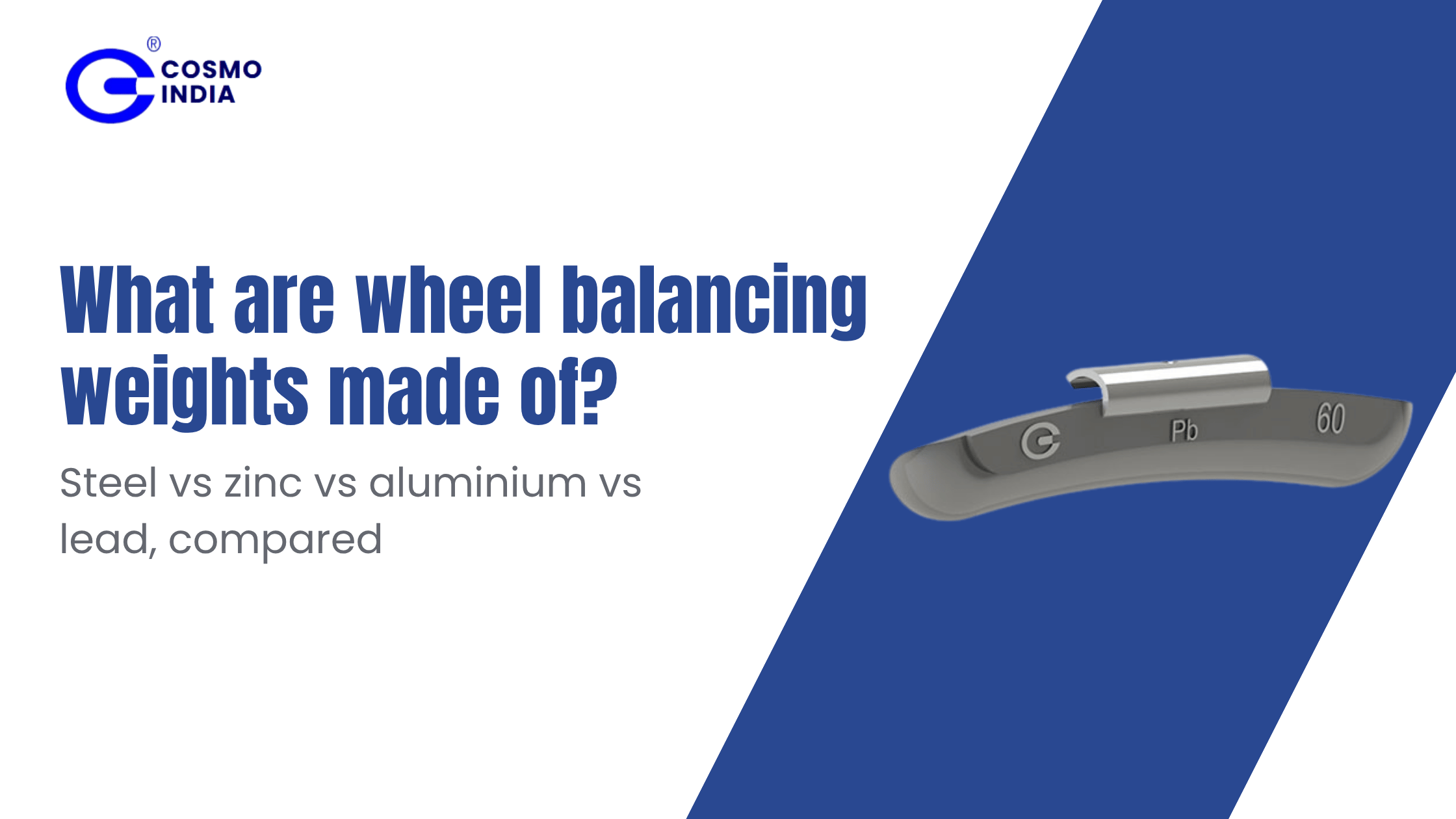
Wheel balancing weights are made of three main materials: steel, zinc and lead. Steel and zinc are the lead-free options and are now the most widely specified. Lead is the oldest material and is still made, but it is restricted or banned in several markets. Aluminium is rarely a weight material on its own – when you see it in a listing, it usually means weights for aluminium wheels, not weights made of aluminium.
Quick reference: the materials compared
|
Material |
Density (approx.) |
Same grams, so the weight is… |
Lead-free? |
Corrosion behaviour |
|---|---|---|---|---|
|
Lead |
11.3 g/cm³ |
Smallest |
No |
Does not rust, but surface dulls over time |
|
Steel / iron |
7.8 g/cm³ |
Larger than lead |
Yes |
Can rust if uncoated – normally supplied coated |
|
Zinc |
7.1 g/cm³ |
Larger than lead, similar to steel |
Yes |
Resists corrosion well |
|
Stainless steel (SS) |
7.8 g/cm³ |
Similar to steel |
Yes |
Best corrosion resistance of the steel family |
|
Aluminium |
2.7 g/cm³ |
About four times the size of lead |
Yes |
Resists corrosion, but too light for most wheel weights |
Density is the reason size changes. A balancing weight has to deliver exact grams. The less dense the metal, the more of it you need to reach those grams.
Why the material of a wheel weight matters at all
A wheel weight has one job: to be a stated number of grams, in a stated place, for as long as it stays on the wheel. Material affects all three parts of that job.
First, size. Because lead is the densest of the three main materials, a 40-gram lead weight is smaller than a 40-gram steel or zinc weight. On a wheel with little space – tight clearance behind an alloy rim, for example – size can decide what fits.
Second, staying the same weight. A weight that corrodes loses material, and a weight that loses material is no longer the grams it claims to be. That is why coatings and corrosion resistance are part of the material question, not a separate cosmetic one.
Third, rules and specifications. Vehicle makers, export markets and some fleet buyers specify lead-free weights. If the specification says steel or zinc, fitting lead is wrong even if the grams are right. The types guide covers how material combines with the clip-on and adhesive types; this article covers the materials themselves. If you are new to the subject, the starting point is our guide to what wheel balancing weights are.
Steel wheel balancing weights, and why some are marked Fe
Steel is now the most common material for both clip-on and adhesive weights. It is hard, holds its shape, is lead-free, and costs less than zinc in most markets. Cosmo’s own product photos show it plainly: the clip-on weight is stamped “Fe” and “60g”, and the adhesive strip segments are marked “Fe” as well.
Fe is the chemical symbol for iron, and it answers another search that leads people to this page – iron wheel balancing weights. In product listings, “iron” and “steel” weights refer to the same family. Wheel weights are not made of pure iron; they are made of steel, which is iron with a small amount of carbon and other elements to make it harder and more consistent. A listing that says iron and a listing that says steel are usually describing the same kind of product, not two competing materials.
Steel’s weakness is rust. An uncoated steel weight in a wet, salty environment will corrode, lose material and eventually lose accuracy or grip. That is why steel weights are normally coated. Cosmo’s products are made and coated with materials intended to resist rust and wear, and a buyer should ask about the coating on any steel weight rather than assume it is there.
Zinc wheel balancing weights
Zinc weights are the other main lead-free option. Zinc is slightly less dense than steel, so a zinc weight is a little larger than a steel weight of the same grams, and both are larger than lead. In practice the difference between zinc and steel sizes is small on a passenger car wheel.
Zinc’s advantage is corrosion. It resists rust well in normal road conditions, which is why it is widely used for clip-on weights and specified by many vehicle makers as their lead-free standard. Zinc weights are usually zinc alloys rather than pure zinc, because a small amount of alloying metal makes the casting harder and more accurate. Those alloy recipes can include a small percentage of aluminium, which is one of the places aluminium genuinely appears in wheel weights.
On price, zinc usually sits above steel. Workshops that balance mainly steel-wheeled vehicles in a price-sensitive market often work with steel. Buyers supplying vehicle makers or export markets more often specify zinc. Neither choice is a quality shortcut if the weight is accurately made and properly coated or finished.
Lead wheel balancing weights
Lead was the standard material for decades, for simple reasons. It is the densest material in the table, so weights stay small. It is soft, so a clip-on lead weight forms easily to the rim flange and is easy to fit and remove. It does not rust.
The problem is what happens after a lead weight leaves the wheel. A weight that falls off on the road is ground down by traffic into dust. That is the environmental concern behind the restrictions. The United States Environmental Protection Agency’s page on lead wheel weights records the current position: steel, zinc alloy and composite alternatives are now widely available, vehicle manufacturers no longer install lead wheel weights on new vehicles sold in the United States, and nine US states and Canada have banned them. In the European Union, lead wheel weights have been banned on new passenger vehicles since 2005.
Lead weights are still manufactured and sold, including in India, and Cosmo lists lead among the materials in both its clip-on and adhesive ranges. The practical rule for a buyer is to follow the specification in front of you: the vehicle maker’s requirement, the customer’s requirement, and the rules of the market the vehicle or the weights are going to. Where any of those say lead-free, steel or zinc is the order.
Aluminium wheel balancing weights: the name that confuses first-time buyers
This search term has two meanings, and separating them saves a wasted enquiry.
The first meaning is weights for aluminium wheels. Aluminium alloy wheels usually take adhesive weights fitted inside the rim, because a clip can mark the finish and many alloy rims have no flange profile for a clip. Those weights are made of steel, zinc or lead. The aluminium in the phrase is the wheel, not the weight.
The second meaning is weights made of aluminium. These are uncommon, and the density table shows why. Aluminium is about a quarter as dense as lead and about a third as dense as steel, so a 40-gram aluminium weight would need to be roughly three times the size of a steel one. On most wheels there is no room for that. Aluminium does appear inside some zinc alloys in small amounts, as noted above, but a solid aluminium wheel weight is not a standard product, and Cosmo does not list one.
If a supplier offers you “aluminium weights”, ask which meaning they intend before you order.
SS wheel balancing weights: where stainless steel fits
SS means stainless steel. A stainless weight is a steel weight made from a grade of steel that contains chromium, which gives it much better corrosion resistance than ordinary coated steel.
You will see stainless most often in adhesive weights, where the strip sits inside the rim in a damp, dirty environment and is expected to stay there until the tyre is changed. The trade-off is cost: stainless costs more than coated carbon steel, so it tends to be specified where corrosion is a real problem -coastal use, high-rainfall regions, or buyers who want the longest service life from the weight -rather than as a default for every wheel.
For most buyers, the choice is between coated steel as the standard and stainless as the corrosion upgrade. Both are lead-free, both deliver the same grams, and the balancing result is identical if both are accurately made.
Coating is part of the material decision
Comparing materials without asking about coating gives you half the answer. A steel weight’s corrosion behaviour depends on its coating. A clip’s grip depends on the clip steel and its finish. An adhesive weight’s working life depends on the tape as much as on the metal above it.
Three questions cover most of it when you buy: Is the weight coated, and with what kind of finish? Is the stated gram weight checked in production? Does the coating or finish suit the wheels you fit – for example, will a clip finish mark an alloy rim? Our guide to choosing quality wheel balancing weights goes further on inspection points, and the post on quality wheel balancing weights and smooth rides covers what changes in use when the weight itself is poorly made.
Which material is best? It depends on the job in front of you
There is no single best material, but there is a right material for most situations.
|
Your situation |
Material to start with |
Why |
|---|---|---|
|
General workshop, steel wheels, price matters |
Steel (coated) |
Lead-free, hard, lowest cost of the three |
|
Supplying a vehicle maker or an export market |
Zinc or steel, as specified |
Lead-free specification is usually named by the buyer |
|
Alloy wheels balanced with adhesive strips |
Steel or zinc adhesive |
Both are standard; follow the size and profile the wheel needs |
|
Coastal or high-corrosion use |
Zinc, or stainless steel adhesive |
Better corrosion resistance over the weight’s service life |
|
A customer or market that still specifies lead |
Lead |
Correct only where the specification and local rules allow it |
Notice that balancing quality is not in this table. A well-made weight in any of these materials balances a wheel. The material choice is about size, corrosion, cost and compliance, not about one metal balancing better than another.
Mistakes people make when choosing a material
Choosing lead because it is smaller, without checking the specification. A small weight that breaks the buyer’s lead-free rule is a returned order, not a saving.
Buying uncoated steel for outdoor or coastal use. The saving is small and the corrosion is predictable. The weight loses material, and the balance goes with it.
Reading “iron” and “steel” as different products. They are the same family in these listings, and the Fe stamp on a weight confirms it.
Ordering aluminium weights without asking what the word means. Most of those enquiries are really about weights for alloy wheels, which are steel, zinc or lead weights in adhesive form.
Assuming zinc and steel are interchangeable in a tender. If a specification names one material, supplying the other can fail inspection even though both balance the wheel.
Ignoring the coating and the clip. Material is the headline, but coating and clip quality decide how long the stated grams stay true on the wheel.
Frequently asked questions
What are wheel balancing weights made of?
Most wheel balancing weights are made of steel, zinc or lead. Steel and zinc are lead-free and are the most widely specified today. Lead is the traditional material and is still made, but it is banned or restricted in several markets. Aluminium is rarely used on its own because it is too light.
Which is better, steel or zinc wheel weights?
Both balance a wheel equally well if they are accurately made. Zinc resists corrosion better and is often specified by vehicle makers and export buyers. Steel usually costs less and is the common choice for general workshop use. Zinc weights are slightly larger than steel weights of the same grams, because zinc is a little less dense.
Why are lead wheel weights being replaced?
Because a lead weight that falls off a wheel is ground into dust by traffic, and lead dust is a health and environmental concern. Alternatives in steel and zinc are now widely available, vehicle makers no longer fit lead weights on new vehicles sold in the United States, and several states, Canada and the European Union have banned them.
What does Fe mean on a wheel balancing weight?
Fe is the chemical symbol for iron. It marks the weight as a steel (iron-based) weight, as opposed to zinc or lead. Cosmo’s clip-on and adhesive weights in steel are stamped Fe along with the gram value, for example “Fe 60g”.
Are iron and steel wheel balancing weights the same thing?
In product listings, yes, in practice. Wheel weights are made of steel, which is an iron-based metal. Some suppliers describe them as iron weights and others as steel weights. Check the coating, the gram accuracy and the type (clip-on or adhesive) instead of treating the two words as two different products.
Do aluminium wheel balancing weights exist?
Solid aluminium weights are uncommon, because aluminium is roughly a third as dense as steel, so the weight would have to be about three times larger for the same grams. Most searches for aluminium wheel balancing weights mean weights for aluminium alloy wheels and those are adhesive weights made of steel, zinc or lead.
What are SS wheel balancing weights?
SS stands for stainless steel. These are steel weights made from a chromium-containing grade of steel that resists corrosion much better than ordinary steel. They are most often used in adhesive form and are usually chosen for coastal or high-moisture use, at a higher cost than coated steel.
Buying by material from Cosmo India
Cosmo India manufactures clip-on weights from 5 grams to 100 grams and adhesive weights in strips and rolls, in steel, lead and zinc, for passenger vehicles, two-wheelers, trucks, HCVs and LCVs. If your requirement names a material – for an OEM specification, an export order or a fleet standard – send that specification with your enquiry to info@cosmo.co.in, and the matching range is on the products page.