In short: Truck balancing weights are clip-on weights — almost always steel — sized for commercial vehicle rims and stocked in the higher gram values trucks actually use. Specifying them properly means four decisions: the gram range your vehicles need, clip profiles that match your rim flanges, a coating that survives commercial duty, and a stocking pattern based on the sizes your workshop really fits, not the full catalogue. Get those four right and balancing stops being a source of comebacks.
Quick reference: specifying truck balancing weights
| Decision | Options | What decides it |
|---|---|---|
| Gram range | Small car values vs higher commercial values | Vehicle class — trucks correct in larger amounts |
| Clip profile | Profiles matched to rim flange shape and thickness | The rims in your fleet or customer base |
| Material | Steel standard; lead and zinc in specific ranges | Rim type, market rules, existing fleet standard |
| Coating | Coated vs uncoated steel | Operating environment and corrosion exposure |
| Pack format | Single-size boxes vs mixed | Fitting volume per size — stock deep on movers |
What truck balancing weights are
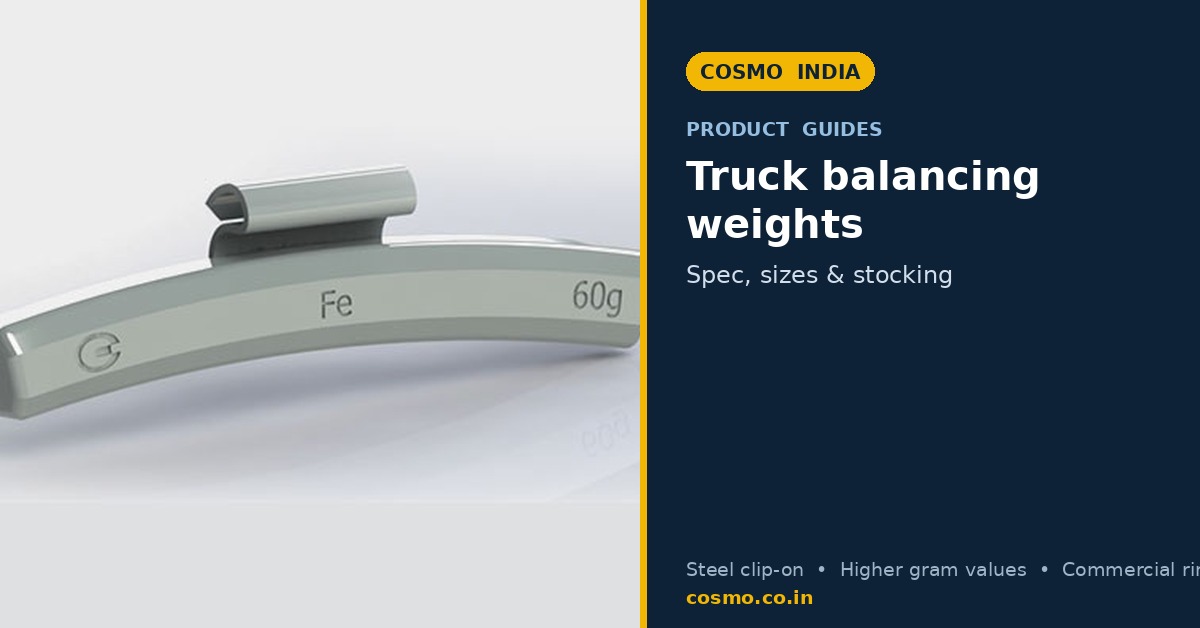
They are the weights a balancing machine calls for when a truck, bus or HCV wheel is measured — pieces of metal in stamped gram values, clipped to the rim flange at the position the machine indicates. The principle is identical to car balancing; the hardware is not. Commercial rims are steel, their flanges are thicker, and the corrections are larger, so the weights are built for that duty. The complete product background — types, fitting and removal — is in our truck wheel balancing weights guide; this post is about choosing and holding the range.
The gram range a truck range actually needs
A workshop that stocks car sizes for truck work runs out mid-job, because truck assemblies routinely call for corrections at the top of the range. Cosmo’s clip-on production runs from 5 g to 100 g; for commercial work the centre of gravity of that range shifts upward — the mid and high values are the daily movers, with small values kept for final trimming. The increments matter as much as the extremes: a range that jumps in big steps forces the technician to over- or under-correct, and the re-spin shows it. Our guide to how much wheel balancing weights weigh explains increments and stamped values in full.
Clip profiles: matching the weight to the rim flange
A clip-on weight holds by spring tension against the rim flange, so the clip must match the flange’s shape and thickness. Commercial rims vary — different manufacturers roll their flanges differently — and a clip profile that seats perfectly on one rim can sit loose on another. A loose truck weight is not a small problem: it leaves a heavy assembly at speed, on a vehicle that may not return to your workshop for months.
The specification step most buyers skip is a fit test across the rim types they actually service. Before committing to volume, fit samples on each rim profile in the fleet, strike them home, and check seating by hand. Suppliers used to commercial work expect this test; it is part of choosing a wheel balancing weight supplier properly, not a favour.
Steel first: materials on commercial vehicles
Steel is the standard truck weight material — strong clips, durable bodies, sensible cost at commercial volumes, and no market restrictions of the kind that affect lead. Lead truck weights exist in some markets and fleets with a long-standing standard, and zinc appears in specific ranges, but for a new specification steel is the default unless a fleet standard or a regulation says otherwise. Whichever material is chosen, consistency across the stocked range matters more than the choice itself: mixing suppliers and profiles size-by-size is how fit problems enter a workshop.
Weight accuracy and tolerance on commercial weights
A truck weight is a measuring instrument that happens to be made of metal: the machine asks for a number of grams, and the weight is trusted to be that number. If the stamped value and the true value part company, every correction built on it is wrong by the same amount, and the technician chases the error with extra weights or accepts a balance that is not one. On commercial work the effect is amplified, because the corrections are larger and the same suspect stock may be fitted across a whole fleet before anyone questions it.
Tolerance is therefore a specification item, not a detail. Ask how the manufacturer samples and weighs production, and run your own incoming check: a sample from each delivered batch on a calibrated scale, compared against the stamped value. Weights that drift consistently under or over their stamp are a batch problem to raise with the supplier, with the scale readings as evidence. This one habit separates buyers who control their balancing quality from buyers who rent it from a machine and hope.
Coating and corrosion protection for working trucks
A passenger car weight lives a sheltered life by comparison. A truck weight lives outdoors: monsoon water, road salt in winter regions, dust, pressure washing and long gaps between inspections. Corrosion attacks it in two places that matter — the body, which loses mass and therefore changes the correction it provides, and the clip, whose spring steel loses tension as it rusts, until the weight leaves the flange it was struck onto.
That is why coating belongs in the specification for commercial weights rather than in the brochure. A properly coated steel weight keeps its mass and its clip tension through the service interval; an uncoated or thinly coated one is a scheduled failure. When comparing two truck weight quotations, treat coating as part of the product: the cheaper quote is often the one where this layer was thinned. Inspect for it at delivery — coating should be even, complete over the clip contact areas, and free of bare patches — and again at service, where its condition predicts how much longer the weight can be trusted.
Steer, drive and trailer positions: same weights, different duty
Position changes what a weight endures. Steer-axle weights live with steering movement and are the first suspects in a vibration complaint. Drive-axle weights work under torque and heat near brakes. Trailer weights may sit untouched for very long periods, which makes coating and corrosion resistance their main test. The weights themselves come from the same range; the inspection habit differs — trailer positions deserve a weight check at every service precisely because nobody looks at them between services. Balancing practice by position is covered in heavy-duty wheel balancing.
Dual wheel assemblies: what changes
Many trucks run dual rear wheels. Each wheel of the pair is balanced as its own assembly, and the weights sit on each rim’s flanges as usual — but access and visibility are worse, which tempts shortcuts: balancing only the outer wheel, or reusing weights disturbed during a tyre change without re-measuring. Both shortcuts store up wear. Continental’s guidance on balancing tires starts from the same principle for all vehicles: the assembly that is measured is the assembly that must be corrected — all of it.
Duals add one specification point of their own: the inner wheel’s weights must clear the outer wheel when the pair is assembled, and both wheels’ valve and weight positions should be arranged so the inner assembly can still be inspected. A weight struck proud on the wrong flange can foul its partner wheel — a fitting detail, but on duals it is the difference between a balanced pair and a damaged one. When a dual pair is split for a tyre repair, treat the refit as a new assembly: re-measure both wheels rather than assuming the old corrections survived the separation unchanged.
Stocking the range: sizes that move, sizes that sit
Fleet and workshop stock should follow fitting records, not catalogue completeness. Track which gram values your technicians actually fit over a quarter, then stock deep on those, shallow on the tails of the range, and review the pattern when the vehicle mix changes. Single-size boxes suit high-volume values; mixed assortments look convenient and quietly strand capital in sizes nobody fits. For export and multi-site programmes, the same stocking logic is agreed with the supplier up front — see the heavy-duty wheel balancing exporter checks.
Specifying for a mixed fleet
Few fleets run one vehicle model on one rim. A mixed fleet — tippers, tractor-trailers, buses, light commercials — means several rim profiles and a wider working gram range, and the specification has to be built from the fleet list, not from a catalogue page. Start by listing the rim types in service and grouping vehicles by rim profile; each group gets its clip profile confirmed by fit test. Then map the gram values each group has actually used over recent balancing records, and set the stocked range from that evidence. Light commercials in the same fleet usually take the lower half of the range, heavy tippers and trailers the upper half, and buses sit between — but the fleet’s own records outrank any general rule. Revisit the specification whenever vehicles are replaced: a new model entering the fleet with a different rim profile is exactly how a workshop ends up forcing the wrong clip onto a flange and calling the resulting lost weight a quality problem.
Signs a truck weight needs replacing
- The clip no longer grips — the weight moves by hand or shows witness marks of sliding on the flange
- Corrosion has eaten the coating and reached the body, weakening the clip’s spring
- The stamped gram value is no longer readable, so the piece cannot be trusted in a measured correction
- The weight has been struck on and off repeatedly and the clip has visibly opened out
A weight is a measured component, not a lump of metal. Once its value or its grip is in doubt, it is scrap.
Mistakes when buying truck balancing weights
- Specifying by price per piece alone, without a clip fit test on the fleet’s actual rims.
- Stocking the full catalogue evenly, so the fast sizes run out while slow sizes gather dust.
- Mixing profiles within one size bin, until technicians cannot tell which clip fits which rim.
- Ignoring coating on vehicles that work outdoors, then replacing corroded weights and re-balancing early.
- Treating trailer positions as fit-and-forget, when they are the positions checked least and corroding longest.
Frequently asked questions
What are truck balancing weights?
Clip-on metal weights, usually steel, in stamped gram values, fitted to a truck or bus rim flange at the positions a balancing machine indicates. They cancel the heavy spots in the wheel assembly so it spins evenly.
What sizes of balancing weights do trucks use?
Trucks use the higher part of the standard clip-on range. Cosmo manufactures clip-on weights from 5 g to 100 g; commercial work centres on the mid and high values, with small values used for final trimming after the main correction.
Are truck balancing weights different from car weights?
Yes, in build rather than principle. Truck weights have clips profiled for thicker commercial steel rim flanges, come in larger gram values, and are specified for heavier duty and longer service intervals than car weights.
Why are most truck balancing weights steel?
Steel gives strong clips, durable bodies and low cost at commercial volumes, and carries none of the market restrictions that affect lead. It is the standard material for commercial steel rims.
How many balancing weights does a truck wheel need?
As many as the machine measurement calls for — commonly a correction on both the inner and outer flange, sometimes more than one piece per flange on large corrections. The number is measured, never standard.
Can adhesive weights be used on trucks?
Rarely, and not as standard practice. Working truck steel wheels, their operating environment and the size of corrections all favour clip-on weights. Adhesive weights belong mainly to alloy car wheels.
Where can fleets buy truck balancing weights in bulk?
Directly from a manufacturer, with rim profiles and gram range specified. Cosmo India supplies fleets, workshops and distributors — send your vehicle mix and rim types to info@cosmo.co.in for a range and stocking recommendation.