In short: Heavy-duty wheel balancing is the balancing of truck, bus and heavy commercial vehicle wheels, where larger, heavier tyre-and-rim assemblies need bigger corrections — usually steel clip-on weights in higher gram values, fitted on both rim flanges after a two-plane machine measurement. It matters more, not less, than car balancing: an imbalance that a car driver feels as a steering tremor becomes, on a loaded truck, a source of uneven tyre wear, suspension wear and driver fatigue over very long distances.
Quick reference: heavy-duty vs car balancing
| Point | Passenger car | Heavy-duty (truck / bus / HCV) |
|---|---|---|
| Typical rim | Alloy or steel, smaller diameter | Steel, larger diameter, often dual rear assemblies |
| Weight type | Clip-on or adhesive, small gram values | Clip-on steel weights, higher gram values |
| Correction size | Small — fine increments | Larger — the assembly itself is far heavier |
| Main cost of ignoring it | Vibration, mild uneven wear | Tyre wear at commercial scale, suspension and bearing wear, driver fatigue |
| Balancing trigger | New tyres, vibration complaint | New tyres, tyre rotation, repair, wear pattern, vibration at highway speed |
What heavy-duty wheel balancing is
Balancing means making the tyre-and-wheel assembly’s mass even around its axle, so it spins without a heavy spot pulling it off centre. The method is the same as for a car — a balancing machine spins the assembly, measures where the heavy spots are and how much correction each needs, and the technician fits weights at the measured positions. What changes in heavy-duty work is the scale of everything: the assembly, the machine’s capacity, the size of the correction and the consequences of skipping it.
Bridgestone’s tyre care guidance makes the general point for all vehicles — wheel alignment and balancing are necessary because an unbalanced assembly wears its tyre unevenly and vibrates at speed. On a commercial vehicle, multiply that by the weight of the vehicle, the cost of the tyres and the kilometres covered between services.
Why imbalance costs more on a heavy vehicle
A truck tyre is a major running cost, and uneven wear shortens its life in the place fleets feel it most — across every vehicle, every month. An unbalanced front assembly also works the steering and suspension components harder with every revolution, and transmits vibration into the cab for the whole of a driver’s shift. None of this needs a dramatic failure to be expensive; it accumulates quietly, which is exactly why it gets neglected.
There is also a load point. A car usually runs near its everyday weight. A truck’s balance behaviour changes with load, but balancing itself is done unloaded on the machine — the goal is an assembly that is true in itself, so it behaves under whatever load the vehicle carries.
Signs a truck or bus needs its wheels balanced
- Vibration through the steering wheel or cab at highway speeds that was not there before
- Uneven or patchy tread wear on steer tyres, especially wear that differs left to right
- A tyre that has been repaired, rotated or replaced since the last balance
- Weights visibly missing from a rim flange after a previous balancing
- Driver complaints of fatigue or a “buzzing” cab on long routes
Vibration has more than one possible cause — alignment, worn components and tyre damage among them — which is why the check starts with inspection, not with the machine. Continental’s tyre knowledge pages describe the same sequence for balancing tires: the assembly is checked, then measured, then corrected.
How heavy-duty balancing is done
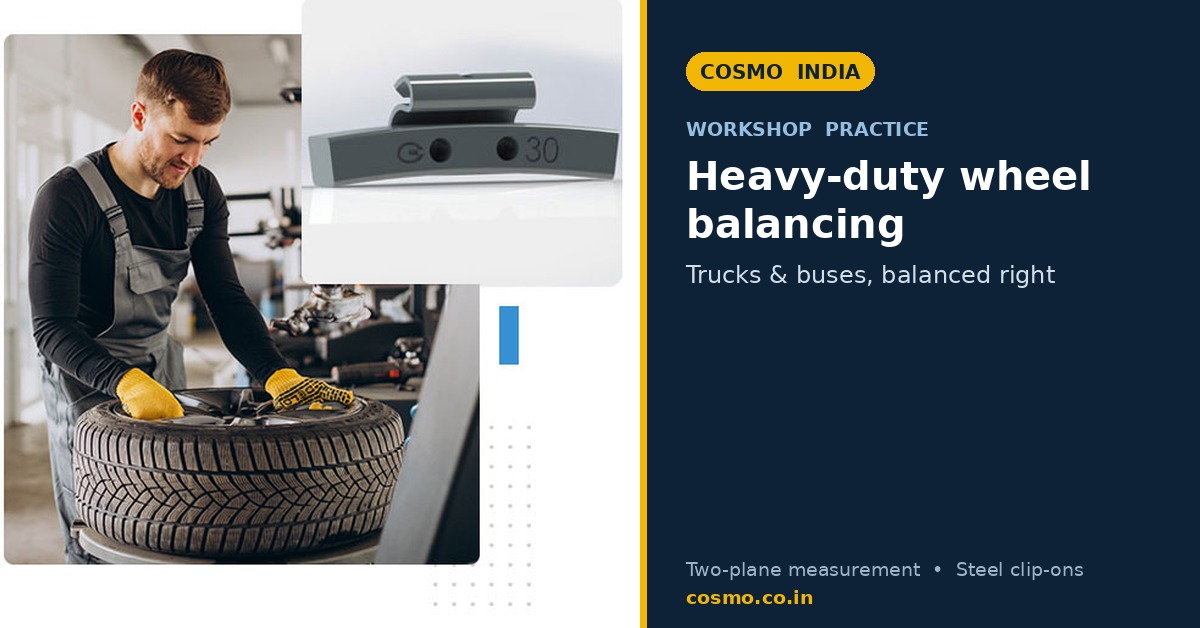
The wheel is removed and mounted on a heavy-duty balancer rated for its size and weight. The technician enters the rim dimensions, spins the assembly, and the machine reports the correction needed on the inner and outer planes of the rim. Weights are clipped at the indicated positions on each flange, and the assembly is spun again to confirm the residual imbalance is within tolerance.
Two details decide the quality of the job. The first is mounting: a heavy assembly that is not centred on the machine exactly as it sits on the hub will measure wrongly, and the correction will be wrong with it. The second is verification: the re-spin after fitting is not a formality, it is the proof. The placement logic is the same as our guide on where wheel balancing weights go — measured positions on two planes, never guesswork.
The weights used on heavy-duty wheels
Steel clip-on weights carry almost all heavy-duty work. They suit steel rims, their clips are built for thicker commercial rim flanges, and the gram values run higher than car ranges — Cosmo’s clip-on range runs from 5 g to 100 g, covering car through heavy commercial corrections. Steel also stands up to the coating and corrosion demands of vehicles that work outdoors year-round.
Adhesive weights have little place on working truck steel wheels: the surfaces, the environment and the size of corrections all favour clips. Whatever type is fitted, weights that later leave the rim undo the job — the causes are covered in why wheel balancing weights fall off, and on heavy vehicles a wrong clip profile for the flange is the usual one. The full product picture is in our truck wheel balancing weights guide.
When to balance heavy-duty wheels
Balance whenever the assembly changes: new tyres fitted, a tyre repaired and refitted, wheels rotated between positions, or a rim replaced. Add balancing to the investigation whenever a wear pattern or a vibration complaint appears, rather than waiting for the next scheduled service. Fleets that balance at every tyre event spend less time diagnosing wear arguments later, because one variable has already been eliminated.
Two more triggers are easy to miss. The first is seasonal: vehicles that change tyre sets with the season start each set’s life with a balance, not with the balance the set had when it was stored. The second is after any wheel-end work — hub, bearing or brake work that disturbs the assembly — because refitting is itself a change to the assembly, and a vibration that appears afterwards will otherwise be blamed on the repair. Balancing at the moment of change costs minutes; balancing as a diagnosis, weeks later, costs the tyre that wore in the meantime.
Trailer and tag-axle wheels: the forgotten positions
Steer axles get attention because the driver feels them. Trailer and tag-axle wheels get none, because nobody sits over them — and they are balanced least, checked least and left longest between inspections. The physics does not care which position a wheel occupies: an unbalanced trailer assembly still wears its tyre unevenly, still works its bearings and suspension, and still sheds its weights unnoticed. The wear simply surfaces later, as a tyre written off early with no recorded explanation.
The practical fix is procedural. Put trailer and tag positions on the same balancing rule as the steer axle — balanced at every tyre event, weights inspected at every service — and record the grams fitted per position. Fleets that do this stop having a category of unexplained trailer tyre wear; fleets that do not keep paying for the same lesson one tyre at a time. It costs little: the wheels are usually off at the same service events anyway.
Balancing records: what a fleet should log
A balancing job that is not recorded cannot be learned from. The useful record is short: vehicle, wheel position, date, the tyre event that triggered the job (new tyre, repair, rotation), the grams fitted on each plane, and the technician or workshop that did it. Kept consistently, those few fields answer questions fleets argue about for months. Is one position eating tyres? The record shows whether it was balanced and with what. Did a wear pattern start after a specific repair? The dates line up or they do not.
Records also close the loop with supply. If weights keep being found missing on one rim type in the fleet, the pattern points at a clip-profile mismatch rather than at individual technicians — a specification problem with a specification fix. Balancing feels like a workshop task, but on a fleet it is also a data task, and the fleets that treat it as both spend less on tyres than the ones that treat it as neither.
Balancing is not alignment — heavy vehicles need both checks
Balancing corrects the spinning assembly. Alignment sets the angles at which the wheels meet the road. A truck can be perfectly balanced and still scrub its steer tyres if the alignment is out, and perfectly aligned while an unbalanced wheel vibrates. On heavy vehicles the two are checked together at tyre events because their symptoms overlap — uneven wear appears in both columns — and separating the causes early is what saves the tyre. The foundations are laid out in wheel balancing weights explained.
Mistakes that undo heavy-duty balancing
- Balancing a dirty or damaged assembly. Mud, stones in the tread or a bent rim flange make the machine measure a wheel that does not exist on the road.
- Skipping the re-spin. The correction is a claim until the machine confirms it.
- Reusing deformed clips. A clip that has been hammered on and off loses tension; on a heavy assembly it will not hold.
- Fitting car-range weights to a truck rim because they are on the shelf — wrong clip profile, wrong retention.
- Balancing only the steer axle by habit when the complaint or the wear is on a drive or trailer position.
For fleets and OEM programmes
Fleets balancing at scale need the supply side organised as well: consistent gram values, clips matched to the fleet’s rim profiles, and stock that does not run out mid-season. That is a procurement question as much as a workshop one, and it is why heavy-duty supply is usually arranged directly with a manufacturer — see our guide to choosing a heavy-duty wheel balancing exporter if your programme buys across borders, or write to info@cosmo.co.in for domestic fleet supply. Cosmo India manufactures clip-on weights from 5 g to 100 g in steel, lead and zinc, at a capacity of 50 million parts per annum.
Frequently asked questions
What is heavy-duty wheel balancing?
It is the balancing of truck, bus and heavy commercial vehicle wheel assemblies. A machine measures the heavy spots in the spinning assembly and the technician fits weights — usually steel clip-on weights in higher gram values — at the measured positions on both rim flanges to cancel them.
How is heavy-duty balancing different from car balancing?
The method is the same; the scale is not. Heavy assemblies are larger and heavier, corrections are bigger, steel clip-on weights replace adhesive ones, and the cost of ignoring imbalance — tyre wear, suspension wear, driver fatigue — is much higher across a commercial fleet.
What weights are used for truck wheel balancing?
Predominantly steel clip-on weights sized for commercial rim flanges, in gram values running higher than car ranges. Cosmo’s clip-on range covers 5 g to 100 g. Adhesive weights are rarely used on working truck steel wheels.
How often should truck wheels be balanced?
At every tyre event — new tyres, repairs, rotations, rim changes — and whenever vibration or an uneven wear pattern appears. Balancing is event-driven rather than calendar-driven.
Can balancing fix uneven tyre wear on a truck?
Only the share of wear caused by imbalance. Wear from misalignment, under-inflation or worn suspension continues until those causes are fixed, which is why balancing and alignment are checked together when wear appears.
Why does an unbalanced truck wheel vibrate only at certain speeds?
Imbalance forces grow with rotation speed, so the vibration appears in a speed band and may fade above or below it. That pattern is a useful diagnostic sign, but the fix is the same: inspect, measure and balance the assembly.
Does load affect wheel balancing on trucks?
Balancing corrects the wheel assembly itself and is done off the vehicle, unloaded. A true assembly behaves under any load; a load cannot correct an unbalanced wheel, it can only change how the vibration is felt.