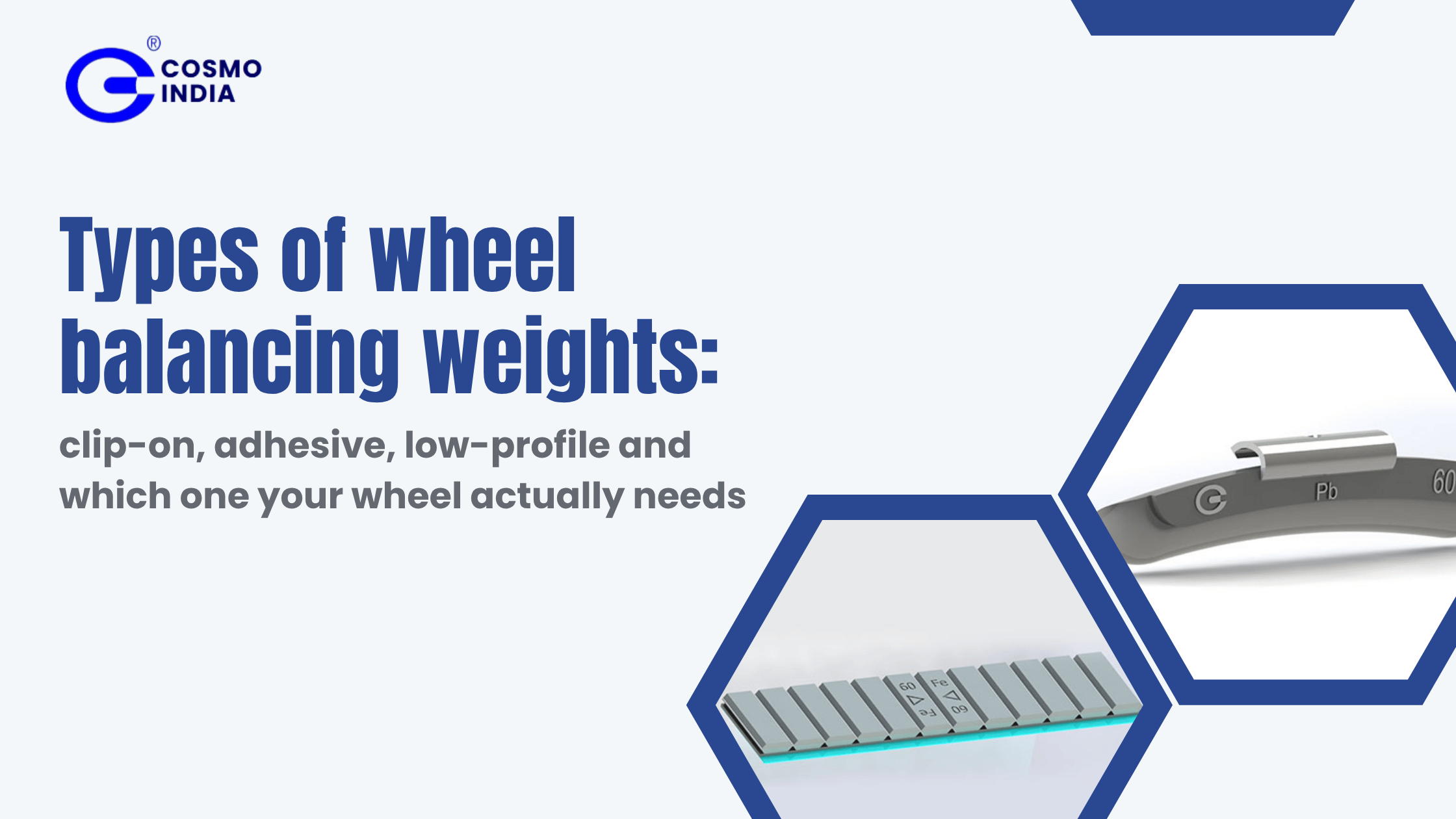
There are two main types of wheel balancing weights: clip-on weights, which clip onto the edge of the rim, and adhesive weights, which stick to the inside of the rim. Clip-on weights are mostly used on steel wheels. Adhesive weights, including thinner low-profile versions, are mostly used on alloy wheels. Within both types, you also choose a material – steel, zinc or lead and a size in grams.
If this is your first time reading about wheel weights, that short version is enough to follow everything below. Each type is explained in plain words, with where it is fitted and what it is fitted to.
Quick reference: the types at a glance
|
Type |
Fitted where |
Best for |
One thing to know first |
|---|---|---|---|
|
Clip-on weight |
On the rim flange (edge of the wheel) |
Steel wheels |
The clip profile must match the rim flange |
|
Adhesive / stick-on weight |
Inside the rim, on the rim barrel |
Alloy wheels |
The rim surface must be clean and dry, or it will not hold |
|
Low-profile adhesive weight |
Inside the rim, where clearance is tight |
Alloy wheels with large brakes or a shallow rim well |
Thinner than a standard adhesive weight, made for tight spaces |
|
Adhesive weight on a roll |
Cut or separated to size at the fitting point |
OEM plants and high-volume workshops |
Same adhesive type, supplied in a form suited to plant use |
Start here: the two families every other type comes from
Almost every name you will see – stick-on, sticky, hammer-on, knock-on, tape-on — belongs to one of the two families in the table above. The difference is only how the weight is attached.
A clip-on weight is held by a metal clip. An adhesive weight is held by tape. That one difference decides most of the rest: which wheel it suits, where on the wheel it sits, how it is fitted, and how it can fail. A clip that does not grip will move. A tape bond on a dirty surface will let go.
Types are also split in two other ways, which often causes confusion for first-time buyers. One split is by material: the same clip-on design can be made in steel, zinc or lead. The other split is by size and shape: a weight for a truck wheel is larger and heavier than one for a small car or a two-wheeler. Material and size sections follow below, after the two main types. If the basics of balancing are new to you, read our pillar guide on what wheel balancing weights are and why a vehicle needs them first, then come back to this page.
Clip-on wheel balancing weights
A clip-on weight is a curved piece of metal with a steel clip on its back. The technician places it on the flange – the lip at the edge of the rim and taps it into place with a fitting hammer, so the clip grips the flange.
Clip-on weights are the standard choice for steel wheels, and they are also used on some alloy wheels that have a flange shaped for them. They are quick to fit and quick to remove, which is why workshops that balance a lot of steel wheels work mainly with this type. Fleet and commercial users favour them for the same reason, as Imperial Supplies notes in its wheel weights guide: clip-ons are the classic design for rim-flange fitting, while adhesive styles sit inside the rim and are less noticeable.
Two points matter with clip-ons. First, profiles differ. Rim flanges are not all the same shape, so a clip-on weight is made in different profiles to match them. A weight with the wrong profile may look fitted and still work loose. Second, the clip can mark a coated or polished rim, which is one reason this type is not the default for alloy wheels.
Cosmo’s clip-on range runs from 5 grams to 100 grams. The fitment profile is suited to passenger vehicles and can be customised to requirement.
Adhesive wheel balancing weights: the stick-on type
An adhesive weight is a flat piece or a strip of small pieces with adhesive tape on the back. The technician peels off the liner, presses the weight onto the inside surface of the rim, and holds it for a few seconds. “Stick-on”, “sticky weights” and “tape weights” are the same thing, not separate types.
This is the standard type for alloy wheels. It sits out of sight inside the wheel, so it does not spoil the look of the rim, and there is no clip to scratch the finish. Adhesive weights are supplied as individual pieces, as pre-cut strips of segments (commonly 5-gram segments that are separated to make up the weight needed), and on rolls. Cosmo supplies its adhesive range in strip form and in rolls for in-plant use and automation, which is the form an OEM assembly line needs.
The bond is the whole job with this type. The rim surface has to be cleaned of grease, brake dust and old adhesive, and it has to be dry. A weight pressed onto a dirty rim may pass the balancing machine check and come off days later. Temperature matters too. Cosmo’s adhesive range is made for use from -20°C to 50°C, so a workshop needs to store and fit it within normal working conditions. Our separate guide on wheel balancing sticker weights and installation best practices covers the fitting steps in full.
Low-profile wheel balancing weights
A low-profile weight is an adhesive weight made thinner than the standard version. It exists for a practical reason: space.
On many modern alloy wheels, the gap between the inside of the rim and the brake caliper or other parts behind the wheel is small. A standard-thickness adhesive weight in that space can foul the caliper as the wheel turns. A low-profile weight sits flatter against the rim, so it clears those parts.
First-time buyers sometimes assume low-profile means a lower gram value. It does not. Profile is about thickness and shape, weight is about grams. A low-profile weight can carry the same gram rating as a standard one; it simply takes up less height. If a workshop tells you a wheel needs low-profile weights, they are talking about clearance in that wheel, not about a different balancing method.
The same types, split by material: steel, zinc and lead
Once the fitting type is decided, the next choice is material. This is where a first-time buyer can get lost, because a product list may show a steel clip-on, a zinc clip-on and a lead clip-on side by side. They are the same type, made in three metals.
|
Material |
Where it stands |
Common use |
|---|---|---|
|
Steel |
Lead-free, hard, holds its shape well |
The common default for clip-on and adhesive weights |
|
Zinc |
Lead-free, resists corrosion well |
Clip-on and adhesive weights where lead-free is specified |
|
Lead |
Dense, so a weight can be smaller for the same grams |
Still used where regulations and customer specifications allow it |
Which material a workshop or a vehicle maker asks for usually follows their specification and local rules on lead, rather than personal choice. Cosmo manufactures both its clip-on and adhesive ranges in steel, lead and zinc, with coatings intended to resist rust and wear. More detail on why the grade of the weight matters is in our post on choosing quality wheel balancing weights.
Inside or outside? Where the weight sits on the wheel
Several of the searches that lead to this page ask whether wheel balancing weights go inside or outside. Both positions are used, and the balancing machine decides.
A clip-on weight is fitted on the flange, which can be on the outer face of the wheel, the inner face, or both. Weights on the outside are the ones you can see on a steel wheel when you look at it. An adhesive weight is almost always fitted inside the rim, hidden from view.
The reason for using two positions comes back to dynamic balancing. Correcting a side-to-side imbalance means placing weight in two planes – roughly, an inner plane and an outer plane – rather than one. That is why a balanced wheel often has one weight inside and one outside, and why removing the visible outer weight “to make the wheel look cleaner” unbalances it again. On alloy wheels, the outer-plane correction is usually done with an adhesive weight inside the rim instead of a clip on the visible face. Our post on wheel balancing weights for alloy wheels goes further on that case.
Types by vehicle: car, two-wheeler and truck wheels
The types stay the same across vehicles. The sizes and the amounts of weight needed change.
Passenger cars use the smallest range, with clip-on weights on steel wheels and adhesive weights on alloy wheels. Two-wheelers need small weights suited to narrow rims. Trucks, HCVs and LCVs need larger and heavier weights, and their wheels take more correction because the tyre and wheel assembly is much bigger. Workshops serving commercial vehicles also tend to work with clip-on weights on steel wheels for speed, because those wheels are removed and refitted often.
Cosmo’s ranges cover passenger vehicles, two-wheelers, trucks, HCVs and LCVs across both adhesive and clip-on types. For a buyer, the useful way to shortlist is vehicle first, then wheel material, then fitting type, then size range. Starting from size alone leads to the wrong profile or the wrong type.
How to choose the right type: a first-time checklist
You do not need to memorise the catalogue. Work through these five checks in order.
- Look at the wheel, not the tyre. Steel wheel with a clear rim flange: start with clip-on. Alloy wheel, or a wheel where the finish matters: start with adhesive.
- Check the space inside the wheel. If the rim sits close to the brake parts behind it, ask for low-profile adhesive weights.
- Confirm the material specification. If you are buying for a vehicle maker, a fleet or a chain of workshops, their specification may name steel or zinc. Match it rather than substituting.
- Match the profile and size range. For clip-ons, the profile must match the flange. Keep the gram sizes your balancing work actually calls for, rather than a full range you rarely use.
- Ask how it is supplied. Strips suit a workshop counter. Rolls suit plant and automated use. Buying the right supply form saves time every day, not once.
If you are a vehicle owner rather than a buyer, you do not choose the type yourself. Your part is smaller: after a balancing job, ask which type was fitted and check a few days later that no weight has come off. A missing weight means the wheel needs rechecking.
Mistakes first-time buyers and users make
Buying on the type name alone. “Adhesive” does not tell you the size range, the segment size, or whether the tape suits your working temperature. Check the specification behind the name.
Using a clip-on weight on an alloy wheel because it was in stock. If the flange profile does not match, the weight can mark the rim or come off. Stock is not a reason to change type.
Assuming stick-on weights are weaker. A correctly fitted adhesive weight on a clean rim holds well. The failures people describe are nearly always surface preparation failures.
Treating low-profile as a cheaper or lighter option. It is a clearance solution. Choosing it where a standard weight fits adds nothing, and choosing a standard weight where clearance is tight creates a fouling problem.
Mixing up material and type. Ordering “zinc weights” without saying clip-on or adhesive is an incomplete order. Type first, then material, then size.
Ignoring what the balancing machine is asking for. If a wheel repeatedly needs a very large correction, the problem is more likely the tyre seating or the rim than the weight. Changing the type of weight will not fix it. Continental’s guide to balancing tyres lists the points at which a wheel should be rebalanced, including after a repair or a hard pothole strike, which are the same moments a lost or wrong weight is usually discovered.
Frequently asked questions
What are the different types of wheel balancing weights?
The two main types are clip-on weights, which clip onto the rim flange and are mainly used on steel wheels, and adhesive weights, which stick to the inside of the rim and are mainly used on alloy wheels. Low-profile weights are a thinner version of the adhesive type, made for wheels with tight clearance behind them. All types are also made in different materials: steel, zinc and lead.
Which is better, clip-on or adhesive wheel weights?
Neither is better in general. Clip-on weights suit steel wheels and are fast to fit and remove. Adhesive weights suit alloy wheels, stay out of sight and do not mark the rim finish. The wheel decides the type. Using the type the wheel was designed for gives a more reliable balance than choosing by preference.
What are wheel balancing sticky weights?
Sticky weights are adhesive wheel weights. They are supplied as flat pieces or as strips of segments with adhesive tape on the back, and they are pressed onto the inside surface of the rim. The name comes from how they are fitted, not from a different function.
Do wheel balancing weights go inside or outside the wheel?
Both. Clip-on weights are fitted on the rim flange, which can be on the outer or inner face of the wheel. Adhesive weights are fitted inside the rim. Many wheels need a weight in two positions to correct side-to-side imbalance, so seeing one weight inside and one outside is normal.
What is a low-profile wheel balancing weight?
It is an adhesive weight made thinner than the standard version, so it fits inside wheels where the gap between the rim and the brake caliper is small. Low-profile refers to the thickness of the weight, not to its gram rating.
Can I use clip-on weights on alloy wheels?
Only where the alloy wheel has a flange profile made for a clip-on weight. Many alloy wheels do not, and a clip can mark the finish or fail to grip. In most cases an adhesive weight fitted inside the rim is the right choice for an alloy wheel.
Which type of wheel weight should a workshop stock first?
A workshop that mainly services steel-wheeled cars should stock clip-on weights first, in the profiles it sees most. A workshop that mainly services alloy-wheeled cars should stock adhesive strips first, with low-profile weights for tight-clearance wheels. Most mixed workshops stock both, because the wheel in front of them decides the type.
Next step if you are buying for a workshop, fleet or plant
Shortlist by vehicle and wheel type first, then ask for the size range and supply form. Cosmo India manufactures clip-on weights from 5 grams to 100 grams and adhesive weights in strips and rolls, in steel, lead and zinc, for passenger vehicles, two-wheelers, trucks, HCVs and LCVs. The full range is on the products page, and specific profile or size requirements can be sent to info@cosmo.co.in.