The price of wheel balancing weights is set by what the weight is made of, what type and size it is, how many you buy, and how well it is finished. There is no single market price, because two weights with the same gram value stamped on them can be built to very different standards — different metal, different tolerance, different clip or tape — and each difference carries a cost. The factors below let you read any quotation and see where its number comes from — and where a suspiciously low one saved money.
What determines the price: quick reference
| Cost factor | What varies | Effect on the price |
|---|---|---|
| Material | Lead, steel or zinc, at different metal costs | The largest single driver |
| Type and profile | Clip-on vs adhesive; standard vs low-profile | Shaped, low-profile forms cost more |
| Gram size | Small segments vs large weights | More metal per piece in larger sizes |
| Quantity and packaging | Retail packs vs bulk formats | Unit cost falls as volume rises |
| Coating, finish and tape | Corrosion protection; adhesive grade | Better protection and tape cost more |
| Brand and approvals | OEM-approved, certified production | Documented quality is priced in |
| Freight and taxes | Distance, order size, taxes | Sets the landed cost you pay |
Material: the largest single factor
A wheel weight is mostly metal, so the price of that metal sets the floor under every quotation. Lead, steel and zinc trade at different prices and differ in density, so the metal content of a given gram value differs across materials. When raw metal prices move, weight prices follow — a quotation held open for months is usually re-priced for this reason alone.
Material choice is rarely free, either. A buyer supplying OEMs or export markets may be required to use a lead-free material, while another segment still buys lead. The three metals are compared in the guide to what wheel balancing weights are made of. A zinc quote and a lead quote are prices for different products; comparing them directly says nothing about which supplier is cheaper.
Type, profile and gram size
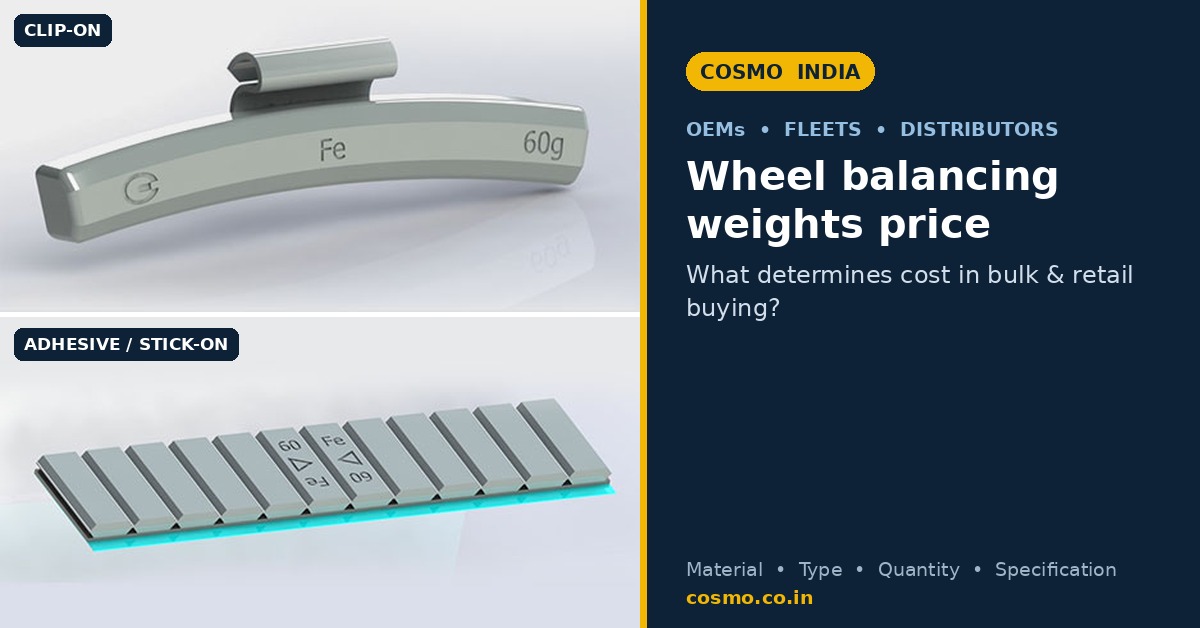
A clip-on weight is a shaped body plus a hardened steel clip, made in several flange profiles; an adhesive weight is a row of segments on rated tape. Low-profile forms and profiles needing their own tooling add manufacturing cost over a plain standard shape.
Gram size works the obvious way: a larger weight contains more metal, so unit price rises with size. This is one reason per-piece comparisons mislead — one box may hold small adhesive segments, another large clip-on weights. Like-for-like means the same type, profile, material and gram value from both suppliers.
Coating, finish and tape quality
Protection is a priced layer. A coating that keeps a weight from corroding through monsoon seasons costs more than a minimal finish, and the clip’s steel and heat treatment decide whether it keeps its grip. These are the costs a cheap weight removes first, because none of them shows on the day of purchase.
On adhesive weights, the equivalent item is the tape. Adhesive rated across a wide temperature range, bonding reliably to a prepared rim, costs more than a basic foam tape. Tape grade is part of the specification — a strip that falls off inside a month was not cheap at any price. Both fixing types are detailed in the clip-on weights guide and the adhesive weights guide.
Order quantity and packaging
Volume changes the economics at every step. A large production run spreads setup, tooling and packing costs across far more pieces than a small batch, and freight per unit drops as consignments grow. Hence bulk pricing sits below trade, which sits below retail: the product may be identical, the cost of getting it to you is not.
Packaging belongs to the same factor. Retail-ready small packs, boxed strips sorted by gram value, and rolls for in-plant use carry different packing costs. Check both quotes are for the same format: bulk loose and retail packed describe different amounts of work.
Brand, approvals and quality systems
A weight produced under an audited quality system, with tolerance checks and traceability, carries costs a basic product does not: inspection, testing, documentation, certification, plus OEM approval testing where it applies. Buyers who need those assurances — vehicle manufacturers, export customers, large fleets — pay for them in the unit price; the paperwork is part of the purchase.
This is also where abnormal cheapness should be questioned. Imperial Supplies’ look at wheel weights and their cost argues it from the buyer’s side: the saving on the weight is small against the labour and comeback cost of failure. Evaluating the supplier behind a quotation is covered in the guide to choosing a wheel balancing weight supplier.
Freight, taxes and landed cost
The quoted price is not the paid price. Freight depends on distance and consignment size — weights are dense for their size, so transport is a real line item, especially for small orders sent far. Taxes add to the invoice total. The figure for your costing is the landed cost: product, packing, freight and taxes together, divided by the quantity received. It is also why a distant manufacturer’s quote and a local stockist’s shelf price can both be reasonable — they price different combinations of product, quantity and delivery.
Bulk vs retail buying, and why per-piece comparisons mislead
A retail buyer pays per pack for immediacy: small quantity, packed for the shelf, available today. A bulk buyer pays per specification: a defined material, type, gram range and tolerance, in volume, on a lead time. Judging either price by the other’s terms misleads.
Per-piece comparison is the weakest measure of all, because pieces are not units of anything useful. Compare instead by cost per balanced wheel — the total cost of the weights used to balance one wheel, in the material and standard the job requires. Bulk buyers can also use cost per kilogram of correct-specification weights, which strips out piece size. Both measures force the comparison back to specification, where cheap weights quietly differ. The buying routes themselves, including retailers and marketplaces, are compared in the guide to where to buy wheel balancing weights.
Questions to ask before accepting a quotation
Which material, exactly? Get the metal named on the quote, not just the gram value.
What tolerance are the weights held to? Ask how stamped-weight accuracy is controlled and checked.
Is the price for the same type, profile and format? Clip-on profile, adhesive form and packaging must match across quotes.
What does the adhesive rating cover? For strips and rolls, ask the tape’s rated temperature range.
Are freight and taxes included? Convert every quote to landed cost before comparing.
How long is the price valid? Metal-driven pricing moves; a validity period shows how the supplier handles that.
Can I test samples first? On a new supplier, samples of the exact quoted specification should precede a bulk order.
Red flags of abnormally cheap weights
Underweight product. Weights short of their stamped grams: less correction than the label claims, and every balance off.
Weak clips. Soft or poorly treated clip steel loses tension, and the weight leaves the flange.
Poor tape. Adhesive that lifts in heat, cold or moisture turns strips into a recurring failure, not a saving.
Thin or missing coating. Corrosion starts early, staining wheels and weakening the weight.
No specification on paper. A quote that will not name material, tolerance or format asks you to trust what it will not state.
Mistakes when comparing wheel balancing weight prices
Comparing pieces instead of specification. Different types, sizes and materials are different products.
Comparing quoted price instead of landed cost. Freight and taxes change the ranking of two quotes.
Assuming the lowest price is the same product. The differences that matter are invisible in a price list.
Ignoring the cost of failure. A fallen weight costs a second balancing job, worth many weights.
Locking a long-term price without a metal clause. Without one, the supplier either absorbs metal movements and recovers them elsewhere, or the price changes some other way.
Frequently asked questions
What is the price of wheel balancing weights?
There is no single price, because the product is not single. Price depends on material, type, profile, gram size, quantity, packaging, finish and quality standard, plus freight and taxes. A figure means nothing without the full specification and quantity attached — which is why this article explains the factors instead of quoting numbers that would not apply to your requirement.
Why are zinc wheel balancing weights priced differently from lead ones?
The metals trade at different prices and differ in density, so raw material cost and the amount of metal per weight both differ. Zinc is also bought for lead-free requirements, where it is the specified material, not an optional upgrade.
Why do bulk prices differ from retail prices?
Volume spreads manufacturing, packing and freight costs across many more pieces, so unit cost falls. Retail packs add small-quantity packing and distribution costs. The product may be the same; the cost of supplying it in that form is not.
How can I compare two suppliers’ prices fairly?
Fix the specification first — material, type, profile, gram values, tolerance, packaging and quantity — then convert both quotes to landed cost and compare cost per balanced wheel or per kilogram of that specification. Add the sample checks: stamped-weight accuracy, clip tension, tape performance.
Are cheap wheel balancing weights worth buying?
Only if they meet the same specification. Cheap usually means something was removed: metal, tolerance control, clip quality, coating or tape grade. The saving per weight is small; the cost of a failed weight — a repeat balance — is not.
What is the cost of wheel balancing weights in India?
It follows the same factors as anywhere: material, type, specification, quantity and landed cost to your location. The useful step is a quotation against a written specification; Cosmo India supplies these for bulk and trade requirements at info@cosmo.co.in.
Getting a quotation from Cosmo India
Cosmo India quotes against requirement rather than publishing a price list, because price follows specification and quantity. It manufactures clip-on weights from 5 to 100 grams and adhesive weights as pieces, strips and rolls, in steel, lead and zinc, at its Gurugram plant (capacity 50 million parts per annum). For a comparable quotation, include material, types, gram sizes, packaging format and quantity. Write to info@cosmo.co.in, or see the range on the products page.