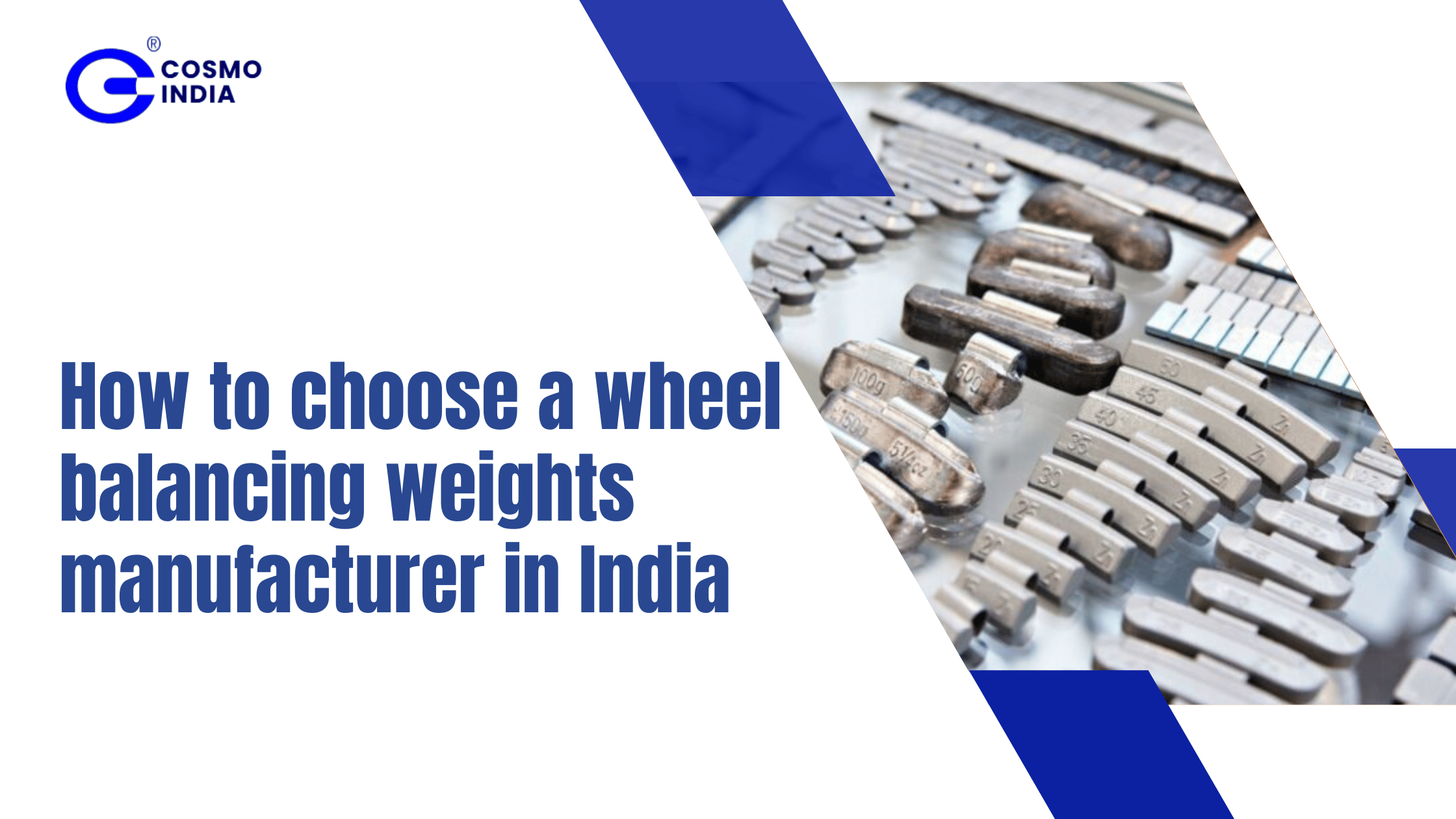
To choose a wheel balancing weights manufacturer in India, check the things that decide whether every consignment matches the first sample: production capacity, in-house tooling, control over the material, weight tolerance testing, and certifications you can verify. Then check OEM experience, export readiness, MOQs and lead times. A manufacturer that answers these points clearly and lets you audit the plant is a safer choice than one competing on price alone.
The checklist below is written for OEM buyers, distributors, fleet suppliers and export buyers who need the same specification, order after order.
Manufacturer, trader or assembler: know who you are dealing with
Some sellers manufacture weights in their own plant. Others buy finished weights, repackage them and sell under their own name. A third group assembles clip-on weights from bought bodies and bought clips.
Ask where the weights are made and whether you can visit. A manufacturer can show you the line, the tooling and the testing setup; a trader usually cannot. The difference matters when a batch fails: the manufacturer can trace the fault to a tool, a material lot or a process step, while a trader can only replace the boxes.
Ask early, because pricing, customisation, tolerance control and complaint handling all depend on who actually makes the part. For the trade-buying side of this decision, see how to choose a wheel balancing weight supplier.
The evaluation checklist at a glance
| What to check | What good looks like | Warning sign |
|---|---|---|
| Production capacity | Stated annual capacity, running lines you can see | Vague answers, no plant access |
| Tooling | Own dies and moulds, maintained in-house | All tooling outsourced, no spares |
| Material control | Declared material per product, checked on receipt | “Metal” with no grade or source |
| Weight tolerance | Sampled and checked on calibrated scales | No testing you may see |
| Certifications | Current, verifiable with the issuer | Expired or unrelated certificates |
| OEM experience | Named vehicle or component customers | Only anonymous claims |
| Export readiness | Transit-proof packing, complete documents | Loose packing, paperwork left to buyer |
Capacity and consistency of supply
Ask for annual capacity in pieces, and how much is already committed. Capacity decides whether the manufacturer can absorb your peak-season order without pushing your delivery back.
Consistency matters more than the headline number. The same tooling, material and process settings produce weights that match from January to December. Ask how repeat orders are controlled: are dies logged, are samples from each batch retained? Scale also protects a distributor: spare capacity lets a manufacturer step up when a fleet contract or export order lands suddenly.
Tooling, materials and weight tolerance
A clip-on weight is only as good as its die and its clip. The body must match the rim flange profile, and the clip must grip without springing open. Manufacturers with in-house tooling can hold the profile, correct wear and develop a new size when one is asked for — fitment depends on it, as the clip-on wheel balancing weights guide shows.
Material is the second control point. Weights are made in steel, zinc and lead, each different in size, corrosion behaviour and regulation — compared in the materials guide. You need a declared material for every product, checks on incoming material, and no silent substitution between orders: a lower-grade casting in the same box only shows up at the balancing machine.
Tolerance is the third. A weight stamped 40 grams must weigh close to 40 grams, every time. Ask how weights are sampled and weighed, what tolerance the plant works to, and whether you can see the records. Adhesive weights need the same discipline, plus tape rated for the wheel’s temperatures.
Certifications worth verifying
Certificates are easy to claim and not hard to verify, so verify them. For automotive supply, the relevant set is IATF 16949 for automotive quality management, with ISO 14001 (environmental management) and ISO 45001 (occupational health and safety) alongside. A ZED certification adds a government-backed check on quality practices.
Ask for copies, note the issuing body and expiry date, and check the scope covers the plant and products you are buying — a certificate held by a group company for a different line does not cover your weights.
Material regulation belongs here for export buyers. Lead wheel weights are restricted in several overseas markets, and the US EPA’s position on lead wheel weights explains why: alternatives are widely available and US automakers no longer fit lead on new vehicles. If you export, confirm the manufacturer can supply steel or zinc equivalents.
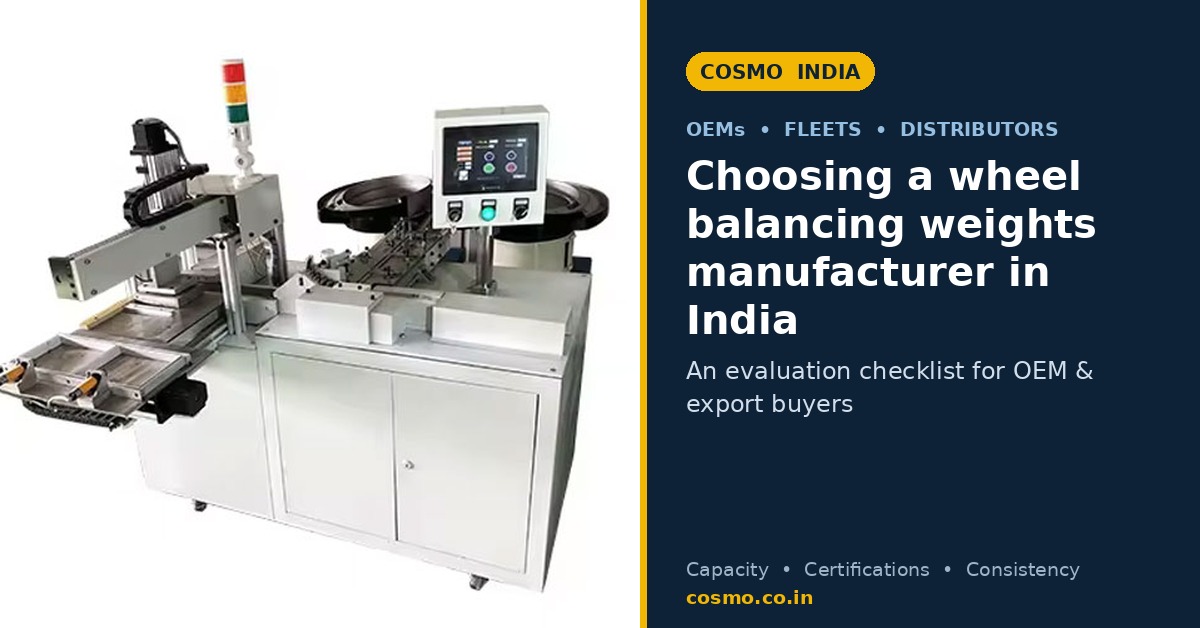
OEM experience and approvals
Supplying an OEM is a different discipline from supplying the open market. Vehicle and component makers audit plants and approve parts through documented processes. A manufacturer that already supplies OEMs has passed those audits — evidence you can use.
Ask which vehicle makers or tier suppliers the plant serves, and whether the names are public. A manufacturer that names its OEM customers on its own website is standing behind the claim.
Export orders: packaging and documentation
Weights are dense, and cartons that collapse damage them in transit. For export orders, check the packing before the price: box strength, carton specification, palletisation and moisture protection.
Documentation needs the same attention. Invoices, packing lists and the test or material certificates your market requires should be routine output from the manufacturer’s office. For wholesale buying, the cost side is covered in the guide to wheel balancing weights price.
MOQ, lead times and the questions to ask before ordering
Get the commercial terms in writing. The questions that prevent most disputes are simple: What is the minimum order quantity per size and profile? What is the lead time for a first order and for a repeat? What happens to a consignment that fails inspection at your end — replacement, credit or rework?
Also settle the range question. A distributor needs the full working range from one source: clip-on weights across the gram sizes vehicles actually use, and adhesive weights as pieces, strips and rolls. Splitting the range between two suppliers adds cost and inconsistency to every batch.
Regional manufacturers and the Coimbatore question
Searches for manufacturers in India often carry a city name, and Coimbatore is one of the most searched. Buyers like a supplier they can visit, and regional engineering clusters do produce competent small manufacturers — nothing here argues against buying regionally.
The comparison to make is capability, not geography. A regional manufacturer may suit a local distributor with modest volumes. A national OEM supplier is set up for audited quality systems, large repeat volumes, export documentation and a full range from one plant. Put the same questions to both and compare the answers, the plant visit and the batch records — not the distance from your office. “Near me” in a search result tells you where a seller is, not how it controls tolerance.
Mistakes buyers make when choosing a manufacturer
Choosing on price per kilogram alone. Cheap weights with loose tolerance cost more at the balancing machine than they save at purchase.
Approving a sample and never checking production. Ask how production batches are sampled, and keep your own incoming checks.
Skipping the plant visit. Photographs and certificates can be borrowed; a working line and batch records cannot be staged for long.
Accepting undeclared material. If the material is not on the specification, it can change without notice.
Ignoring rejection terms. The time to agree what happens with a failed consignment is before the first order, not after the first failure.
Splitting the range across suppliers. Mixed sources mean mixed profiles and tolerances in your stock, with no single supplier accountable.
Frequently asked questions
Who are the wheel balancing weights manufacturers in India?
India’s manufacturers range from large OEM suppliers with audited plants to small regional producers. The established names supply vehicle makers, export regularly and publish their capacity and certifications. Cosmo India, based in Gurugram, is one: 25+ years in the business, plant capacity of 50 million parts per annum, and OEM customers named on its site including Maruti Suzuki, Mahindra & Mahindra, Tata Motors, Fiat and Wheels India. Evaluate any manufacturer, including Cosmo, against this guide’s checklist. Product background: wheel balancing weights explained.
How do I verify a manufacturer’s certifications?
Ask for copies and check the issuing body, the expiry date, and whether the scope covers the plant address and your products. For automotive supply, look for IATF 16949, with ISO 14001 and ISO 45001 alongside it. Anything unclear can be confirmed with the issuer.
What MOQ should I expect when buying wholesale?
MOQs vary with the manufacturer, the product and whether sizes are standard or customised. Rather than relying on a general figure, ask for the MOQ per size and profile in writing, along with lead times for first and repeat orders.
Is it better to buy from a regional manufacturer or a national supplier?
It depends on volume and quality requirements. A regional manufacturer can work well for local distribution and smaller, frequent orders. A national OEM supplier is the stronger choice when you need audited quality systems, large repeat volumes, export documentation or a complete range from one source.
Can an Indian manufacturer supply weights for export markets?
Yes, established Indian manufacturers export regularly. Check packing strength for sea freight, moisture protection, and documentation such as invoices, packing lists and material or test certificates. Also confirm steel or zinc equivalents if your market restricts lead.
What is the difference between a manufacturer and a supplier?
A manufacturer makes the weights in its own plant, controlling tooling, material and tolerance. A supplier or trader buys finished weights and resells them. Suppliers are useful for small and mixed orders; manufacturers are the right contact for volume, custom specifications and consistent repeat supply.
Does Cosmo India supply OEMs and distributors?
Yes. Cosmo India manufactures wheel balancing weights in Gurugram and supplies OEMs, distributors and export buyers. Its range covers clip-on weights from 5 to 100 grams and adhesive weights as pieces, strips and rolls, in steel, lead and zinc, for passenger vehicles, two-wheelers, trucks, HCVs and LCVs. Certifications shown on its site are IATF 16949, ISO 14001, ISO 45001 and ZED Gold.
Talk to a manufacturer before you commit
For an OEM programme, distribution range or export order, start with the specification: types, sizes, profiles, materials and volumes. The full range is on the products page, and enquiries go to info@cosmo.co.in. Bring this checklist to the conversation — a manufacturer worth choosing will answer it without hesitation.