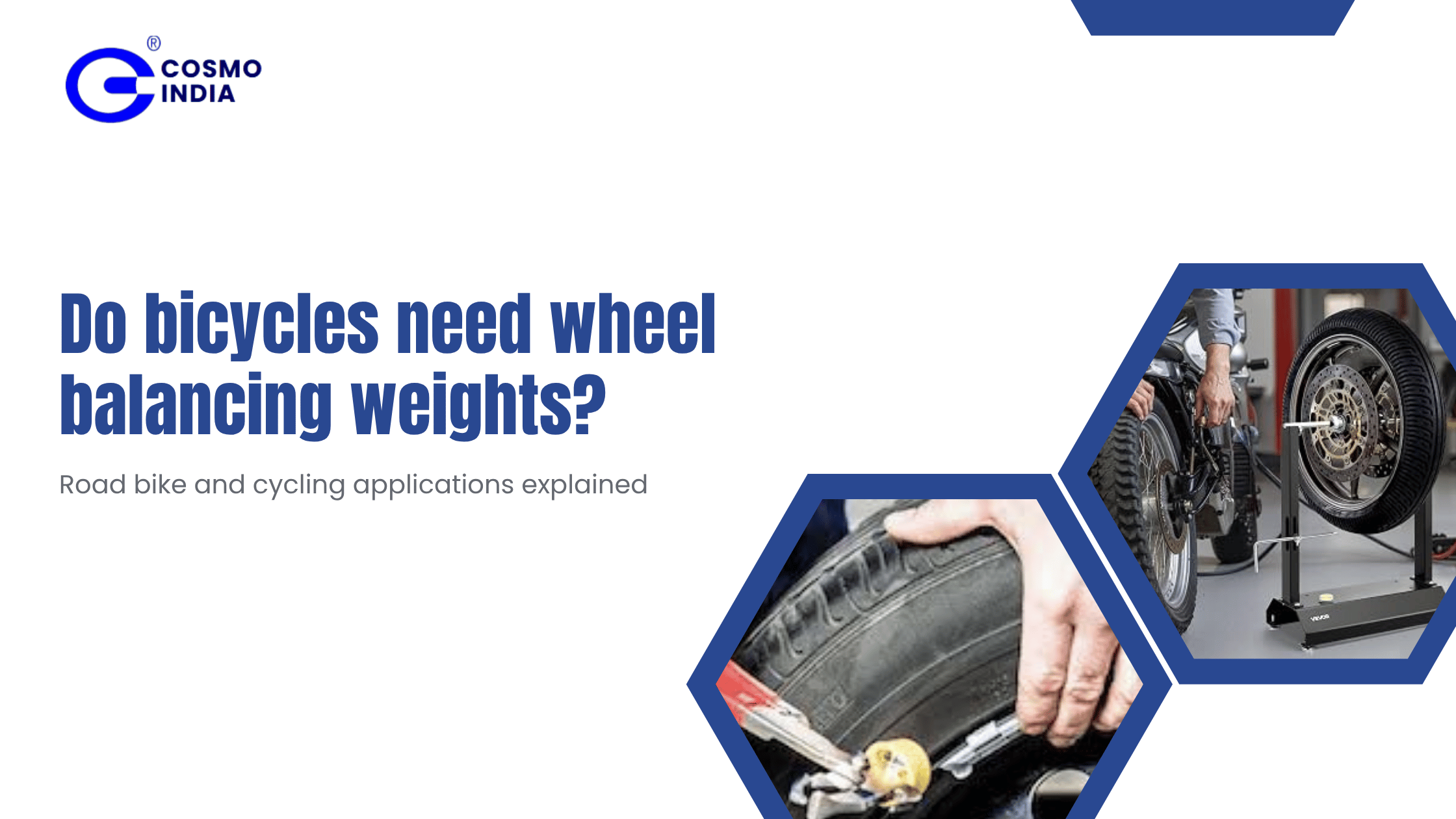
For almost all bicycles, no. A bicycle wheel turns slowly compared with a motor vehicle wheel and carries little rotating mass, so the imbalance that matters on a car or motorcycle is too small to feel on a bike. What riders usually blame on balance is something else: a tyre that has not seated evenly on the rim, a wheel that is out of true, or the valve stem making one spot of the rim slightly heavier. Those faults are fixed by seating the tyre properly and truing the wheel, not by adding weights. There are exceptions — fast e-bikes, downhill bikes, track bikes and some deep-section carbon wheels — where small adhesive weights genuinely are used, and this article covers them. Cosmo India makes balancing weights for motor vehicles, not bicycles; what follows explains the principle, so riders can judge the claims made for bicycle weights.
Why bicycles get away without balancing
The force from an imbalanced spot grows sharply as wheel speed rises. That is the whole reason balancing exists on motor vehicles, as the wheel balancing weights explained guide sets out: at highway speed, a few grams in the wrong place shake a car.
A bicycle misses every condition that makes those grams matter. Road speeds are a fraction of motor vehicle speeds, and even a fast descent is brief. The wheel itself is light, so the unevenness in its weight is small to begin with. And the rider’s weight, carried through the frame, is large compared with anything happening at the rim. A heavy spot that would be obvious on a motorcycle is lost in the ordinary movement of a bicycle on a real road surface. This is why there is no balancing step in normal bicycle wheel building: for ordinary riding there is nothing for it to correct.
What riders actually feel, if not imbalance
Most “my wheel feels unbalanced” complaints trace back to one of these:
| What you feel | Likely cause | The actual fix |
|---|---|---|
| A hop or thump once per wheel revolution | Tyre bead seated unevenly on the rim | Deflate, reseat the tyre, and check the bead line sits evenly all the way round |
| A side-to-side wobble as the wheel turns | Wheel out of true | True the wheel and even out the spoke tension |
| A bulge or soft patch felt through the bars or saddle | Tyre casing damage or a failing tyre | Inspect the tyre closely and replace it if the casing is damaged |
| A buzz that appears only at high speed on an e-bike | The valve stem and rim joint forming a heavy spot | The rare real case — a small adhesive weight opposite the heavy spot |
| Pulsing under braking | A brake rotor or rim brake track problem | Check the rotor or brake track, not the balance |
Work through the causes in that order before thinking about weights. The first two account for the great majority of cases, and both are cheap to check: spin the wheel slowly and watch the bead line against the rim, then watch the rim itself against a brake pad or a fixed point.
The heavy spot every bicycle wheel already has
Every bicycle wheel does have one deliberate heavy spot: the valve. The valve stem, and any extender fitted to it, sits at a single point of the rim, and the rim’s own joint adds material at another point. On many rims the joint sits opposite the valve hole, which partly cancels the valve’s effect.
On a standard aluminium road wheel this is a non-issue at bicycle speeds. It starts to matter where heavy valve hardware and high speed come together — deep-section carbon rims with long valve extenders, ridden fast downhill or on a quick e-bike. That is one of the few combinations where riders fit a small weight opposite the valve.
When weights are genuinely used on bicycles
The exceptions share a pattern: higher speed, heavier wheels, or both.
High-speed e-bikes. Sustained speeds well beyond normal pedalling pace, held for whole journeys rather than short descents, bring wheels into the range where a heavy spot can be felt as a buzz.
Downhill bikes. Heavy tyres and rims, run at genuinely high speeds on the clock. The rotating mass is the largest in cycling, and so is any unevenness in it.
Track and velodrome riding. A perfectly smooth surface and sustained high speed remove the road noise that normally hides small disturbances, so small imperfections show up.
Cargo and fat-tyre setups. Wide, heavy tyres carry more unevenly distributed material, and loaded cargo bikes run that mass for long distances.
Deep-section carbon road wheels. Long valve extenders on an aero rim concentrate weight at the valve, and fast descending gives the speed to feel it.
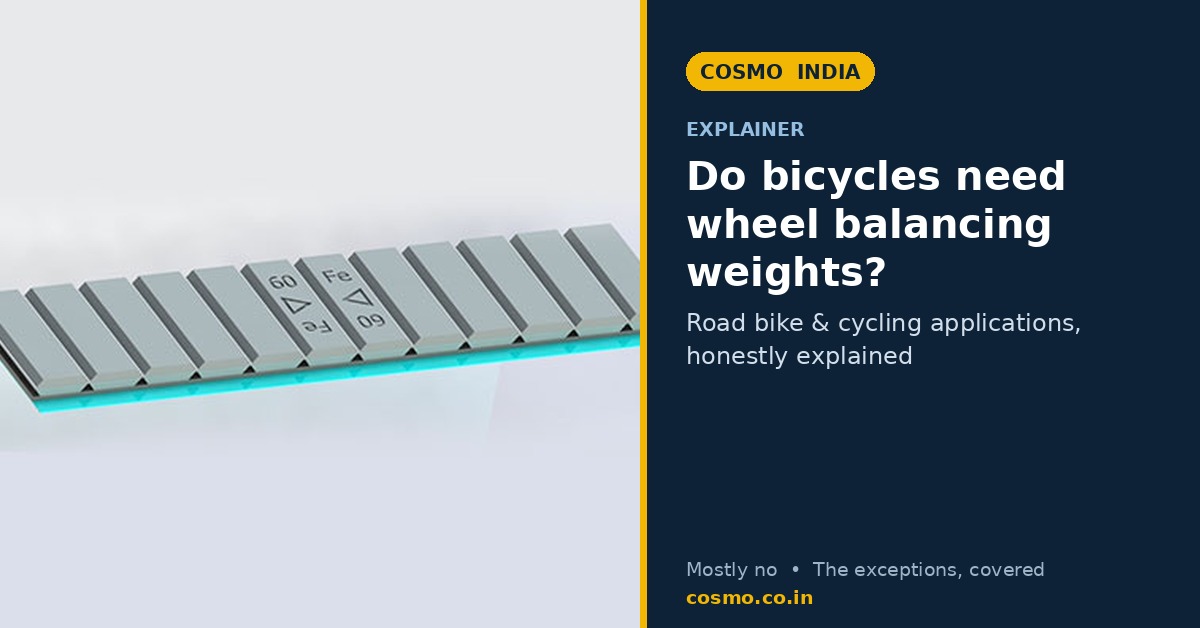
In every one of these cases, the weights used are small adhesive segments of a few grams — the same form as the strips described in the adhesive wheel balancing weights guide, cut short. Nobody balances a bicycle with car-size weights.
How small adhesive weights are fitted in those cases
The method follows the same placement logic as motor vehicle wheels, set out in where wheel balancing weights go: find the heavy spot, then put the correction opposite it.
On a bicycle the heavy spot is found without a machine. The wheel is spun gently in a stand or with the bike lifted, and watched as it slows: a wheel with a heavy spot settles with that spot at the bottom, repeatedly. The rim surface at the opposite point is cleaned and dried, a small segment is pressed on, and the test is repeated, adding a little at a time until the wheel no longer settles in one place. It is slow, approximate work — another reason it is only worth doing in the exception cases above.
What “self balancing” weights mean for bicycles
Searches for bicycle balancing often land on products sold as self-balancing: beads or a liquid placed inside the tyre or tube, claimed to move to the light spot as the wheel turns and keep correcting it continuously.
The idea is borrowed from motor vehicle practice, where internal balancing media are a known alternative to fitted weights — the conventional fitted types are listed in the types of wheel balancing weights guide. On a bicycle, though, the physics works against the claim: distributing loose material around a tyre takes rotational speed and mass, and a bicycle wheel offers little of either. Where a bicycle does have a balance problem worth fixing, a measured, fitted weight does the job directly. For the typical rider, a self-balancing product is a purchase aimed at a problem the bike does not have.
Check these before reaching for weights
Before any weight goes near a bicycle wheel, four checks come first. Is the bead line even on both sides, all the way round? Does the rim run true, side to side and up and down? Is the tyre casing sound, with no bulge, cut or soft patch? Is there play in the hub bearings? If any answer is wrong, fix that — weights over a seating or trueness fault mask the symptom while the real problem keeps wearing the tyre.
Mistakes in bicycle wheel balancing
Adding weights to an out-of-true wheel. The wobble is the rim’s shape, not its weight distribution. True it first.
Treating a seating problem with grams. An unevenly seated tyre hops once per revolution no matter what is stuck to the rim.
Fitting motor-vehicle-size weights. The genuine bicycle cases need a few grams. A full adhesive strip is far too much and creates the imbalance it was meant to remove.
Expecting weights to cure a braking pulse. Pulsing under braking is a rotor or brake track fault. Balance has nothing to do with it.
Buying self-balancing products before checking the tyre. The checks above cost nothing and find the real fault in most cases.
Frequently asked questions
Do road bikes need wheel balancing weights?
Almost never. At road bike speeds and wheel weights, imbalance is too small to feel, and what riders notice is nearly always tyre seating or rim true. The exception is a deep-section carbon wheel with a heavy valve extender used for fast descending, where a few grams opposite the valve can settle a high-speed buzz.
Why does my bike wheel wobble at speed?
Work through the likely causes in order: the tyre bead seated unevenly, the wheel out of true, or tyre casing damage. A wobble that grows with speed on an e-bike can also come from the valve heavy spot. True imbalance of the kind motor vehicles suffer from is at the bottom of the list.
What are road bike wheel balancing weights?
In the rare cases they are used, they are small adhesive segments of a few grams each, pressed onto the rim opposite the heavy spot — usually the valve. They are the same kind of weight used on motorcycle and car alloy wheels, cut down to bicycle size.
Does the valve stem unbalance a bicycle wheel?
It is the heaviest single point on most bicycle wheels, and long extenders on deep-section rims make it heavier. At normal speeds the effect is far too small to feel. It becomes relevant only combined with high sustained speed, as on fast e-bikes or long descents.
Do e-bikes need their wheels balanced?
Standard e-bikes at assisted commuting speeds, no. Fast e-bikes that hold high speeds for long stretches are the closest thing in cycling to a motorcycle case, and a heavy spot can be felt on them. Even then, check seating and true first — they remain the more common causes.
Can I use adhesive weights meant for motorcycles on a bicycle?
The small segments, yes, in the exception cases — a few grams pressed inside the rim opposite the heavy spot. Motorcycle balancing as a whole is a different job, covered in the motorcycle wheel balancing weights guide. Do not fit a full strip: bicycle corrections are a few grams at most.
Are self-balancing wheel weights worth it on a bicycle?
For most riders, no. Loose beads or liquid inside the tyre need more speed and mass than a bicycle wheel provides to distribute themselves as claimed. Check the tyre seating and wheel true first; if a genuine heavy spot remains in one of the exception cases, a small fitted adhesive weight is the direct fix.
A note from Cosmo
Cosmo India does not make or sell bicycle weights, and this article was not written to pretend otherwise. Cosmo manufactures wheel balancing weights in Gurugram for the vehicles where balancing is a measured workshop job — cars, trucks and two-wheelers among them. Enquiries about motor vehicle weights: info@cosmo.co.in.