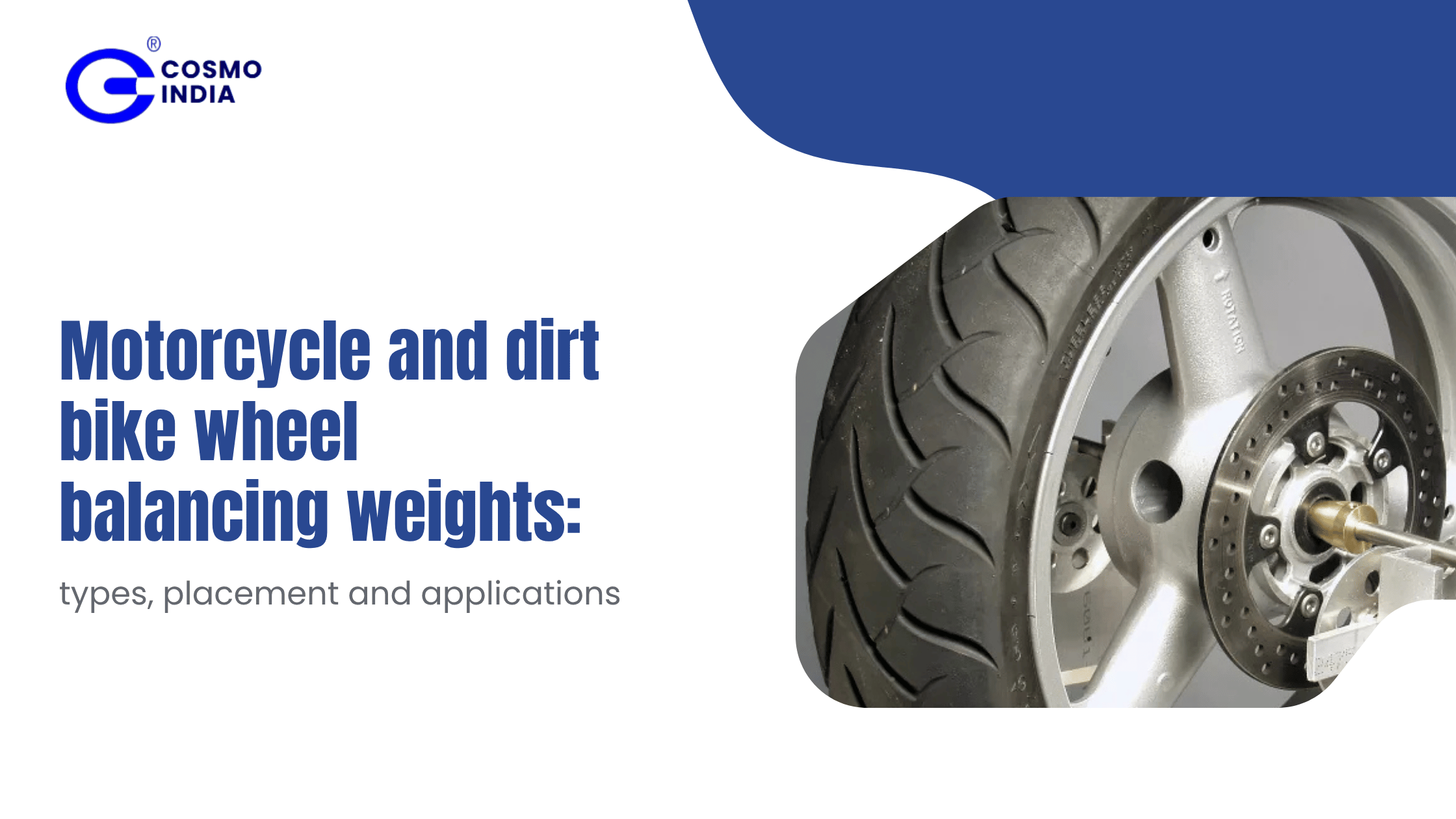
A motorcycle wheel is balanced with the weight type its rim allows. Spoked wheels take spoke weights that crimp or screw onto the spoke nipples. Cast and alloy wheels take small adhesive weights inside the rim barrel, or clip-on weights where the flange is shaped for them. Dirt bikes are the special case: the rim lock fitted inside the wheel is a heavy fitting at one point, so a larger spoke weight is often needed opposite it. Two-wheelers are among the vehicles Cosmo India’s weights serve, and the principle is the same as on any wheel — measure first, then fit the grams where the balancer indicates.
Why balance matters more as speed rises
A car driver feels a bad balance as a shake through the steering wheel. A rider feels it through the handlebars, the footpegs and the seat, on a machine kept upright by its wheels. An imbalanced front wheel can set up a wobble that grows with speed, and an imbalanced rear wheel sends a buzz through the whole bike on a long ride.
At town speeds a few grams out makes little difference, which is why many riders never think about balance. As speed rises, the force produced by an imbalanced spot rises with it, and the shake that was invisible at 40 km/h is obvious at highway pace. The tyre pays as well: an imbalanced wheel does not wear evenly, because the heavy spot loads the same section of tread harder once every revolution. A rider holding vibrating bars for hours also tires faster. None of this needs large weights to fix — motorcycle corrections are usually small — but the weights do need to be in the right place.
The weight types used on motorcycle wheels
Three types cover nearly every motorcycle wheel on the road. The types of wheel balancing weights guide covers the full range across all vehicles; the motorcycle applications are these:
| Weight type | Fitted to | Where it sits | Notes |
|---|---|---|---|
| Spoke weight | Spoked wheels | Crimped or screwed onto spoke nipples near the rim | Sized to the nipple; a correction can be split across neighbouring spokes |
| Adhesive weight | Cast and alloy wheels, some tubeless spoked wheels | Inside the rim barrel, opposite the heavy spot | Needs a clean, dry surface; slim profiles clear the brake caliper |
| Clip-on weight | Rims with a flange shaped for a clip | On the rim flange | Profile must match the flange, as on car wheels |
Choosing between them is not a matter of preference — the rim decides. A spoked wheel has no flat barrel surface in the right place and no flange for a clip, so the spokes carry the weight. A cast wheel has no spokes, so the weight goes inside the barrel or onto the flange.
Spoked wheels: weights that fit on the spokes
A spoke weight is a small metal weight made to grip a spoke nipple — the fitting at the rim end of each spoke. Some designs crimp onto the nipple; others screw or clamp on. Where a correction is larger, fitting several small weights across two or three neighbouring nipples spreads it along the rim instead of loading a single spoke.
Spoked wheels are still common: classic and retro models, adventure bikes, cruisers and nearly all dirt bikes use them. The weights sit close to the rim, at the position the balancer shows, and the result is checked the same way as any other wheel — spin again and confirm the imbalance has gone. Because they sit on the nipples, they can be moved or changed at a tyre change without touching the rim finish.
One limit matters on older wheels: balance cannot correct a spoked wheel that is out of true. If the rim hops or runs sideways as it turns, true the wheel first. Weights fix weight distribution, not rim shape.
Cast and alloy wheels: adhesive and clip-on weights
Most modern commuters, sports bikes and tourers run cast wheels. These are balanced the way car alloy wheels are: adhesive strips are cut to the gram value needed and pressed inside the rim barrel, as covered in the adhesive wheel balancing weights guide, or clip-on weights are fitted to a flange whose profile suits a clip, per the clip-on wheel balancing weights guide.
Two things differ from car practice. The gram values are smaller, so strips are cut into short lengths and accuracy matters more than quantity. Clearance is also tighter: a weight inside the barrel must clear the brake caliper and, on the rear wheel, the chain run — low-profile adhesive weights exist for exactly this reason. And the barrel has to be cleaned of chain lube, brake dust and grime, and dried fully, or the strip will lift.
Where the weights go on a motorcycle wheel
The general rules are set out in the guide to where wheel balancing weights go: on the rim, at the position the balancer indicates, opposite the heavy spot. Motorcycle rims add one detail — they are narrow. Where a car wheel is corrected in two planes, inside and outside, a narrow motorcycle rim is often corrected in a single plane, with adhesive weights along the centre of the rim barrel. Spoke weights follow the same logic at nipple height. What never changes is the order: find the heavy spot first, then place the weight opposite it.

Dirt bikes: the rim lock changes the job
A dirt bike wheel carries a rim lock — a metal clamp inside the rim that stops the tyre creeping around the rim at the low pressures used off road. It does its job, but it is a heavy fitting concentrated at one point, and it leaves the wheel badly imbalanced before the tyre’s own irregularities are counted. The fix is weight opposite it, usually a larger spoke weight or a group of spoke weights on the nipples across from it — which is why dirt bike wheels carry noticeably more balancing weight than road bike wheels.
Many riders skip balancing for slow off-road use, and at trail speeds the imbalance is genuinely hard to feel. The calculation changes on a dual-sport bike that also runs on tarmac: at road speeds the rim-lock imbalance shakes the bars and wears the knobbly tyre unevenly. If the bike spends real time on the road, balance the wheel — and expect the rim-lock correction to be the biggest part of it.
How a motorcycle wheel is balanced
Workshops use two methods. A machine with motorcycle adapters spins the wheel and reports the grams and the position, exactly as with a car wheel. A static balancer supports the wheel on its own axle between low-friction bearings and lets the heavy spot settle at the bottom; weights are added opposite it until the wheel stays wherever it is left. Either way, the sequence matches the shared procedure in the installation and removal guide: start from a bare rim, measure, fit, then check again.
Sizes and materials
Motorcycle corrections sit at the small end of the range and are added in small increments — adhesive strips are made of small segments for this reason. The materials follow the wider market: steel, zinc and lead weights are all in use. Cosmo India supplies clip-on weights from 5 to 100 grams and adhesive weights as pieces, strips and rolls, in steel, lead and zinc, and lists two-wheelers among the vehicles it serves — the small end of that range covers motorcycle fitments.
Mistakes in balancing motorcycle wheels
Balancing an out-of-true spoked wheel. Weights cannot fix rim shape. True first, balance second.
Guessing the position. The balancer finds the heavy spot; a weight placed where it looks neat does nothing.
Fitting adhesive strips over chain lube and grime. On a rear wheel especially, the barrel has to be cleaned and dried or the strip will lift.
Ignoring the rim lock on a dirt bike. It is the largest single imbalance on the wheel; balancing that leaves it out will not settle the wheel.
Loading one spoke with a single heavy weight. Spread a larger correction across neighbouring nipples instead.
Skipping the check. Spin the wheel again, or roll it on the static stand again — the second check proves the first fitting worked.
Frequently asked questions
Do motorcycle wheels need balancing?
Yes. Corrections are smaller than on car wheels, but an imbalanced motorcycle wheel vibrates through the bars, pegs and seat, and the effect grows with speed. It matters most at highway pace, though a dirt bike with a rim lock carries a real imbalance at any speed.
What weights are used on spoked motorcycle wheels?
Spoke weights — small weights that crimp or screw onto the spoke nipples near the rim. They suit spoked wheels because there is no flange for a clip and no suitable flat surface for an adhesive strip. A larger correction is split across neighbouring nipples.
Where do motorcycle wheel balancing weights go?
On the rim, opposite the heavy spot the balancer finds. Spoke weights sit on the nipples, adhesive weights inside the rim barrel — usually along its centre line — and clip-on weights on the flange where the rim has one.
Why does my dirt bike wheel need so much weight?
Because of the rim lock. The clamp that stops the tyre creeping at low pressure is a concentrated heavy fitting, and the weight opposite it has to match it. A dirt bike wheel carrying far more weight than a road bike wheel is normal, not faulty.
Can I balance a motorcycle wheel at home?
With a static balancing stand, yes, if you work patiently: let the heavy spot settle, add weight opposite, and repeat until the wheel stays put in any position. A workshop machine is faster and reads the grams directly. What does not work is guessing — a weight fitted without finding the heavy spot first can make the wheel worse.
How often should motorcycle wheels be balanced?
At every tyre change, after a tyre repair, and whenever a new vibration appears. Weights are removed and refitted as part of the job, so a tyre change is the natural point to redo the balance from a bare rim.
Do adhesive weights stay on motorcycle wheels?
Yes, when the barrel is cleaned and dried properly and the strip is pressed along its full length. Most losses come from fitting over chain lube, brake dust or a damp surface. On rear wheels, check the strip clears the chain run before refitting the wheel.
Weights for two-wheeler workshops
A workshop balancing two-wheelers needs small-gram adhesive strips that cut cleanly and clip-on profiles that match common flanges. Cosmo India’s range is on the products page — enquiries to info@cosmo.co.in.